
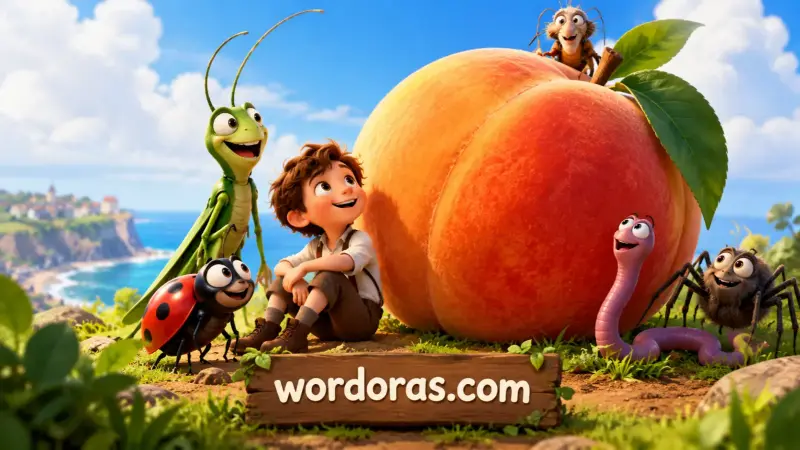
What does James and the Giant Peach really mean? At first glance, Roald Dahl’s famous story seems like a wonderfully strange adventure about a lonely boy, a giant magical peach, and a group of talking insects.
But beneath the funny moments and imaginative setting, the story explores deeper ideas about family, friendship, courage, freedom, and finding a place where you belong.
James begins the story feeling unhappy and alone after losing his parents. He is then forced to live with his cruel aunts, who treat him poorly.
Everything changes when a little magic brings an enormous peach to life. When James enters it, he meets a group of unusual insect friends and begins an adventure far beyond anything he could have imagined.
The meaning of James and the Giant Peach is closely connected to James’s personal growth. His journey shows how friendship and courage can help someone move from fear and loneliness toward confidence and independence.
The giant peach also represents a chance to escape his difficult life and discover a new world.
James and the Giant Peach is more than a fantasy adventure. The giant peach can be understood as a symbol of freedom, friendship, growth, and a safe new home for James. Roald Dahl’s story explores loss, loneliness, curiosity, resilience, acceptance, and the importance of finding people who support you.
What Does James and the Giant Peach Mean?
James and the Giant Peach is a children’s fantasy novel by Roald Dahl, first published in 1961. It follows James Henry Trotter, an orphan who lives unhappily with his cruel aunts, Aunt Spiker and Aunt Sponge. His life changes when a magical peach grows to enormous proportions and becomes the setting for an extraordinary journey.
The title has a literal meaning—the story really does involve a giant magical peach—but the peach also carries deeper symbolic meaning.
At its heart, the story is about escaping isolation and discovering freedom, friendship, confidence, and belonging.
James begins the story lonely and powerless. His journey inside the peach introduces him to companions who accept him, listen to him, and help him become more confident.
So, if you’re asking “What is the deeper meaning of James and the Giant Peach?”, a useful short answer is:
The giant peach represents a pathway out of James’s unhappy life and into a world of freedom, friendship, discovery, and personal growth.
That interpretation is supported by literary analyses that connect the peach with nature, growing up, friendship, acceptance, and belonging.
Why Is the Peach So Important?
The peach is much more than an unusual vehicle.
Before the peach appears, James’s world is extremely limited. He lives under the control of his aunts and is separated from the childhood experiences he longs for.
Then the peach grows.
It creates a completely different environment.
Inside it, James meets unusual creatures who eventually become his friends. Together, they leave his old life behind and face one challenge after another.
This makes the peach a powerful symbol of change.
It takes James:
from isolation → to friendship
😊from fear → to courage
😁from control → to freedom
from loneliness → to belonging
Literary analysis commonly interprets the peach as a nurturing environment where James can grow and develop.
The Main Meaning of the Giant Peach
There isn’t one official sentence from Roald Dahl that says, “The peach means X.”
That’s important.
Literary symbolism is open to interpretation. Different readers can reasonably see several connected meanings in the same object.
The strongest interpretations are:
1. Freedom
The peach physically carries James away from his oppressive home.
It first rolls away from the hill where his aunts live and eventually carries James and his companions across the Atlantic.
In this sense, the peach represents escape and freedom.
James does not simply travel to another place. He gains the opportunity to create a different life.
2. Friendship
The peach becomes a shared home for James and the unusual insects he meets.
They are very different from one another, yet they learn to cooperate and care about each other.
The journey shows James that family and friendship can come from unexpected places.
3. Growth
James changes dramatically during the adventure.
He begins as a lonely child who has little control over his circumstances. As the journey continues, he becomes more confident, resourceful, and willing to take responsibility.
The peach therefore works as a setting for James’s emotional and personal growth.
4. Belonging
The peach gives James something he has been missing: a place where he is accepted.
This is especially meaningful because his biological relatives, Aunt Spiker and Aunt Sponge, do not provide him with the care and belonging he needs.
The peach becomes a temporary home—and eventually leads James toward a new community in New York.
Major Themes in James and the Giant Peach
Understanding the main themes makes the meaning of the story much clearer.
Freedom and Escape
Freedom is one of the most obvious themes.
James is trapped in an unhappy household. His aunts control nearly every part of his life.
The giant peach changes that.
When the peach breaks free and begins rolling away, the physical movement mirrors James’s escape from his old life.
The journey is not always easy. James and his friends face sharks, storms, strange creatures, and other dangers.
But the danger is different from James’s old life.
Now he is actively participating in his own future.
That’s an important distinction.
Freedom does not mean having no problems. It means having the ability to face problems and make choices.
Friendship and Acceptance
James’s new friends are unusual.
They include insects that many people might normally fear or dislike.
Yet James does not judge them simply because of what they are.
Instead, he gets to know them.
The story repeatedly challenges assumptions about appearances. Characters who might seem frightening or unpleasant can become loyal, funny, helpful companions.
This supports a broader theme of acceptance without judging people too quickly.
The insects also demonstrate that a group does not have to be identical to work together.
Their differences become useful.
Nature and Growing Up
Nature plays an important role throughout the story.
James begins by longing to escape the restricted environment created by his aunts. The peach then opens up an enormous natural and imaginative world.
Literary analysis connects this movement through nature with James’s development from childhood toward greater independence.
The journey can therefore be read as a kind of coming-of-age adventure.
James learns to:
- make decisions
- solve problems
- communicate with others
- trust his friends
- deal with unexpected situations
- take responsibility
The magical adventure gives him experiences that his previous life denied him.
Loneliness and the Need for Connection
At the beginning of the story, James is deeply isolated.
He has lost his parents and is living with two adults who treat him cruelly. He also has little opportunity to play or build normal childhood friendships.
The insects change that.
Inside the peach, James finally has companions.
This is why the friendship theme matters so much. The adventure is not only about traveling somewhere new.
It is about finding people with whom James can share the journey.
The story suggests that having supportive relationships can transform how someone experiences difficult circumstances.
What Do the Insects Symbolize?
The insects are not simply comic characters added to make the story strange.
They help reinforce the story’s ideas about difference, friendship, cooperation, and acceptance.
Each creature has a distinct personality.
Each character has a distinct personality, with different strengths, weaknesses, and quirks that shape how they interact with one another.
Yet they gradually function as a team.
This creates an interesting contrast with James’s aunts.
James’s aunts are his biological relatives, but they fail to give him the acceptance and care that he needs.
The insects are strangers, yet they become his friends.
That contrast helps communicate one of the story’s strongest ideas:
Belonging is created through care and connection, not simply through family relationships.
Literary analyses similarly identify the insects and the peach as vehicles for themes of friendship and acceptance.
Aunt Spiker and Aunt Sponge: What Do They Represent?
Aunt Spiker and Aunt Sponge function as the main source of James’s misery at the beginning of the story.
They can be read as representations of cruel authority, selfishness, and restrictive adulthood.
Their relationship with the giant peach is also revealing.
They see the enormous peach as something they can exploit commercially.
James sees it as a place to explore.
That difference reflects two opposing ways of viewing the world:
| James | His aunts |
|---|---|
| Curiosity | Self-interest |
| Exploration | Exploitation |
| Friendship | Profit |
| Imagination | Control |
| Freedom | Restriction |
Literary analysis has noted this contrast between James’s curiosity and his aunts’ desire to turn the peach into something financially useful.
Why Does James Go Inside the Peach?
James enters the peach because he is curious about this strange new phenomenon.
That curiosity becomes one of the turning points of the story.
His aunts treat the peach as a spectacle and opportunity for money.
James approaches it differently.
He wants to investigate.
This reflects another important theme: curiosity can open doors to unexpected possibilities.
The story repeatedly rewards James for being willing to explore rather than simply accepting the limits imposed on him.
Is the Giant Peach a Symbol of Home?
Yes, this is one reasonable interpretation.
Inside the peach, James finds:
- shelter
- food
- companionship
- protection
- friendship
- a sense of community
In other words, the peach temporarily provides many things that his actual home does not.
Some literary analyses therefore interpret it as a kind of ideal home or safe community.
But it is worth avoiding an overly narrow interpretation.
The peach is not only “home.”
It is also a vehicle for transformation.
It protects James while simultaneously taking him somewhere new.
That combination is what makes the symbol particularly effective.
What Does the Journey to New York Mean?
The journey from England toward New York can be read as James moving from his old life toward a new identity.
He starts the adventure without much power.
By the time he reaches New York, he has experienced danger, solved problems, worked with others, and gained confidence.
The destination therefore represents more than geography.
It represents possibility.
After reaching New York, James is welcomed by children and eventually finds a new place for himself. The story ends with him living in the peach stone in Central Park and building a life around his new community.
So the journey can be understood as:
old life → adventure → growth → new community
Why Is the Story So Strange?
The bizarre events are part of the point.
A giant peach.
Talking insects.
A journey across the ocean.
Cloud-Men.
Seagulls carrying a giant fruit.
An arrival at the Empire State Building.
The story does not try to make everything scientifically logical.
Instead, Dahl embraces nonsense, exaggeration, humor, and fantasy.
Literary analysis identifies absurdity and playful imagination as important parts of the novel’s meaning.
The strange events allow readers to experience the story through a child’s imaginative perspective.
Not every event needs a realistic explanation.
Sometimes the adventure itself is the point.
Is James and the Giant Peach About Overcoming Trauma?
It can reasonably be read as a story about overcoming severe loss and adversity, but that should be treated as a literary interpretation rather than a statement of Dahl’s personal intention.
James experiences the death of his parents and subsequent mistreatment by his aunts.
Yet the story does not leave him defined by those experiences.
His life changes through friendship, adventure, curiosity, and independence.
That gives the story a broader message about resilience and the possibility of creating a better future after difficult experiences.
Literary analyses frequently identify perseverance and overcoming adversity among the story’s central themes.
What Does the Ending Mean?
The ending gives James something he has wanted throughout the story: a community where he belongs.
He arrives in New York and eventually becomes known for his extraordinary adventure. The peach stone becomes part of his new life.
This matters because the story does not simply end with James escaping his aunts.
Escape is only the first step.
The more meaningful resolution is that James builds a life after escaping.
He has friends.
😉He has a community.
He has a story to tell.
And he has a future that looks completely different from the one he had at the beginning.
Is There One Official Meaning of James and the Giant Peach?
No.
There is no single interpretation that every reader must accept.
The safest approach is to distinguish between what happens in the story and what readers interpret those events to symbolize.
For example:
- Fact: The giant peach carries James away from his aunts.
- Interpretation: The peach symbolizes freedom.
- Fact: James develops close relationships with the insects.
- Interpretation: The peach represents friendship and belonging.
- Fact: James becomes more confident during the journey.
- Interpretation: The journey represents personal growth.
These interpretations are strongly supported by recurring themes and literary analysis, but they remain interpretations rather than an official author-issued explanation.
Common Misunderstandings About the Meaning
“The peach only represents freedom.”
Not necessarily.
Freedom is an important interpretation, but the peach also connects to friendship, safety, belonging, nature, and growth.
“The story is only about escaping bad adults.”
That’s too narrow.
James’s escape starts the adventure, but the story spends considerable time developing his friendships and showing how he changes.
“Every character must represent one exact idea.”
Not always.
Dahl’s characters can contribute to several themes simultaneously. Literary symbolism does not always work like a one-to-one code.
“The story has to have one hidden secret meaning.”
There may not be one.
Part of the book’s appeal is its playful absurdity. A reader can enjoy the fantasy while also finding deeper themes about childhood, friendship, freedom, and resilience.
FAQs:
What is the main message of James and the Giant Peach?
The story emphasizes freedom, friendship, curiosity, acceptance, resilience, and personal growth. James moves from an isolated and unhappy life toward a community where he is accepted and supported.
What does the giant peach symbolize?
The giant peach can symbolize freedom, friendship, growth, protection, and belonging. It provides James with a safe environment while carrying him away from his old life and toward new experiences.
What is the main theme of James and the Giant Peach?
There are several major themes rather than one single theme. Important ones include friendship, acceptance, freedom, nature, growing up, curiosity, perseverance, and overcoming adversity.
Why does James leave his aunts?
James’s life with Aunt Spiker and Aunt Sponge is unhappy and restrictive. The magical peach provides an opportunity to escape and begin an extraordinary journey.
What do the insects represent in the story?
The insects can be understood as symbols of friendship, acceptance, diversity, and cooperation. Although they are very different from one another, they form a supportive group around James.
Is James and the Giant Peach based on a true story?
No. It is a fantasy children’s novel by Roald Dahl. The giant peach, talking insects, and extraordinary journey are fictional elements. Dahl’s official website describes the story as James’s extraordinary adventure after the peach begins growing at the bottom of his garden.
Final Takeaway:
The James and the Giant Peach meaning is best understood as a combination of several ideas rather than one hidden definition.
The giant peach gives James a way out of an unhappy life, but its importance goes far beyond escape. It becomes a place where he discovers friendship, courage, curiosity, independence, and belonging.
The journey also changes James himself.
He starts as a lonely child with very little control over his circumstances. He ends with friends, confidence, a community, and a new future.
That is why the peach works so well as a symbol: it carries James away from the life that confines him and toward the life he is capable of creating.
And beneath all the talking insects, impossible adventures, and enormous fruit, that is one of the simplest ideas in the book:
Sometimes finding freedom means discovering a new world and discovering who you can become in it.

I’m Allen Vick, the creator of Wordoras.com, a website dedicated to making words, phrases, and their meanings simple and easy to understand.
I’m passionate about clear language and helping readers discover the meaning, usage, pronunciation, and context behind everyday words and expressions. Through Wordoras, I aim to make learning new words simple, practical, and enjoyable for everyone.
1 thought on “James and the Giant Peach Meaning What It Really Means”