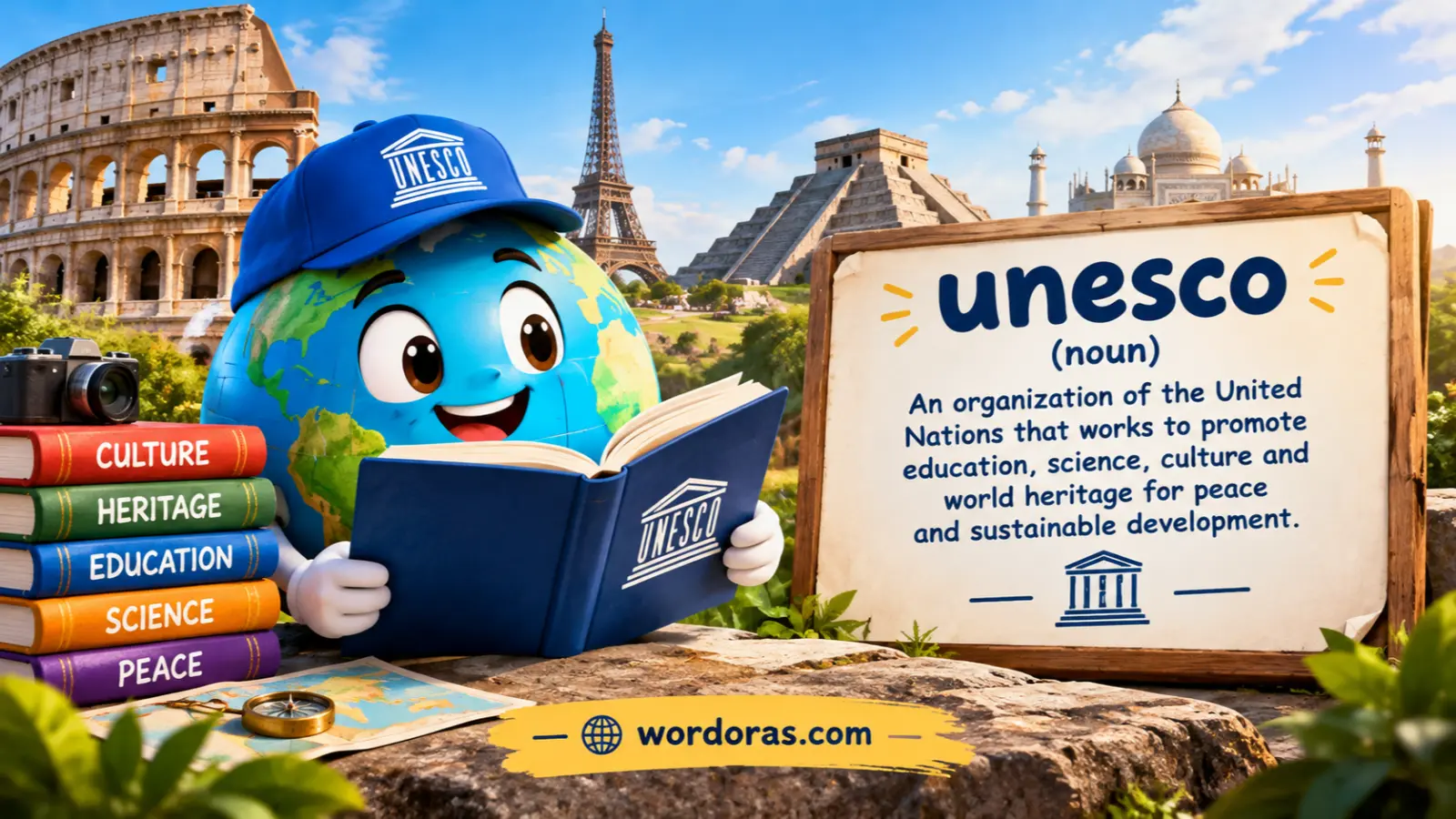
UNESCO meaning is often searched by people who want to understand what this well-known international organization does and why it matters. UNESCO stands for the United Nations Educational, Scientific and Cultural Organization.
It is a specialized agency of the United Nations that works to promote education, support scientific cooperation, protect cultural heritage, and encourage communication and understanding between countries.
You may have come across the name UNESCO while reading about famous historical landmarks, ancient monuments, natural wonders, or World Heritage Sites.
For example, places such as the Great Wall of China and the Taj Mahal are recognized as UNESCO World Heritage Sites because of their outstanding cultural or historical importance.
However, UNESCO does much more than recognize remarkable places. Its work also includes improving access to education, supporting scientific research, protecting cultural traditions, and promoting freedom of expression.
In this guide, you will learn what UNESCO means, what the acronym stands for, why the organization was established, and how it helps protect important places and knowledge around the world.
By the end, you will have a clear understanding of UNESCO and its role in connecting people through education, science, and culture.
UNESCO stands for the United Nations Educational, Scientific and Cultural Organization. It is a specialized agency of the United Nations that promotes international cooperation in education, science, culture, communication, and information. UNESCO also helps protect cultural and natural heritage, supports access to education, and encourages cooperation between countries to build lasting peace.
What Does UNESCO Mean?
UNESCO stands for the United Nations Educational, Scientific and Cultural Organization. It is an international organization that works with countries to improve education, encourage scientific cooperation, protect cultural heritage, and support the free exchange of knowledge and information.
Unlike everyday texting abbreviations such as LOL or BRB, UNESCO is the name of an official international organization. You will commonly see it mentioned in news articles, school textbooks, travel guides, history lessons, and discussions about historic landmarks.
For example, if someone says, “This ancient city is a UNESCO World Heritage Site,” they mean the place has been recognized under UNESCO’s World Heritage program for its outstanding cultural or natural importance.
In simple English, UNESCO helps countries work together to protect knowledge, culture, education, and important places around the world.
UNESCO Full Form: What Does Each Letter Stand For?
The full form of UNESCO is:
United Nations Educational, Scientific and Cultural Organization.
Each part of the name describes an important aspect of the organization’s work.
| Word | Meaning |
|---|---|
| United Nations | The international organization whose system UNESCO belongs to |
| Educational | Connected with learning, schools, and access to education |
| Scientific | Related to scientific research and cooperation |
| Cultural | Connected with traditions, history, arts, and heritage |
| Organization | A structured body established to carry out a particular mission |
The acronym is formed from the initials of the organization’s English name. It is pronounced as a word rather than usually being spoken as five separate letter names.
Officially, UNESCO is a specialized agency of the United Nations. Its work also covers communication and information, alongside its well-known educational, scientific, and cultural activities.
What Is UNESCO in Simple English?
UNESCO is a United Nations organization that helps countries cooperate in education, science, culture, and information.
Imagine a historic building that has stood for hundreds of years. It tells a story about the people who built it, their beliefs, and their way of life. If the building is damaged or destroyed, part of that shared history may disappear.
UNESCO works with countries and other partners to encourage the protection of important heritage and to promote the knowledge and cooperation needed to preserve it.
Its work goes beyond historic buildings. It also supports better educational opportunities, scientific collaboration, cultural diversity, and access to reliable information.
Here is a simple way to understand its main areas:
- Education: Encouraging inclusive, quality learning and lifelong education.
- Science: Supporting cooperation on scientific challenges, including environmental sustainability.
- Culture: Helping protect heritage and encourage cultural diversity.
- Communication and information: Promoting access to information, media development, and freedom of expression.
UNESCO does not replace national governments. Instead, it works with countries to develop shared approaches, standards, programs, and practical solutions.
Why Was UNESCO Created?
UNESCO’s history is closely connected to the aftermath of World War II.
After the destruction and suffering caused by the war, countries recognized that lasting peace required more than political agreements. International cooperation, education, cultural understanding, and the exchange of knowledge were also important.
UNESCO’s Constitution was adopted in London on November 16, 1945, and the organization officially came into existence on November 4, 1946, when the Constitution entered into force. <Cite refs={[“turn169861search1″,”turn169861search10”]}/>
Its founding idea was that cooperation between people and nations could help reduce misunderstanding and contribute to peace.
Today, UNESCO continues to pursue that goal through international programs, research, policy guidance, and partnerships.
What Does UNESCO Do?
UNESCO carries out a range of activities. Here are some of the most important ones.
1. Promotes Education
UNESCO works to expand access to quality education and lifelong learning. It supports international cooperation on educational policies and encourages countries to address barriers that prevent people from learning.
For example, UNESCO may help governments develop education strategies, improve literacy programs, or address inequalities in educational opportunities.
2. Supports Scientific Cooperation
Scientific challenges often cross national borders. Climate change, biodiversity loss, water management, and ocean protection are examples of issues that require cooperation.
UNESCO helps countries share scientific knowledge, develop common approaches, and strengthen scientific research and education.
3. Protects Cultural Heritage
UNESCO is widely associated with the protection of important historic buildings, archaeological sites, monuments, and cultural landscapes.
Its World Heritage program encourages countries to identify and protect places considered to have outstanding universal value.
4. Encourages Cultural Diversity
Every community has its own traditions, languages, art forms, and historical experiences.
UNESCO supports the preservation of cultural heritage and encourages respect for cultural diversity. This work can include traditional practices and forms of expression, not just physical landmarks.
5. Supports Communication and Access to Information
UNESCO also works on issues involving access to information, media development, freedom of expression, and the challenges created by changing communication technologies.
These efforts reflect the idea that informed societies and the free exchange of knowledge can contribute to understanding and cooperation.
What Does UNESCO World Heritage Site Mean?
A UNESCO World Heritage Site is a place recognized under the World Heritage Convention for its outstanding universal value.
Such places may be important because of their cultural history, architecture, archaeology, natural features, or ecological significance.
World Heritage Sites generally fall into three categories:
- Cultural sites: Historic cities, monuments, archaeological sites, and other places of cultural importance.
- Natural sites: Areas with exceptional natural features, ecosystems, or biodiversity.
- Mixed sites: Places that meet both cultural and natural heritage criteria.
For example, a historic city might receive World Heritage recognition because of its architecture and its role in human history. A natural area might qualify because of its exceptional landscape or ecological importance.
However, a UNESCO designation does not mean that every aspect of a site is automatically protected or that UNESCO directly owns or manages the place. Countries have responsibilities for protecting their designated heritage, and UNESCO works through the international framework and cooperation established for that purpose.
UNESCO Meaning in Different Contexts
The meaning of UNESCO remains the same in most situations, but the context tells you which part of its work is being discussed.
| Context | Meaning | Example |
|---|---|---|
| Education | International cooperation in learning | “The report discusses UNESCO’s education initiatives.” |
| History | Protection and recognition of heritage | “The monument has UNESCO recognition.” |
| Travel | A place listed as World Heritage | “We visited a UNESCO World Heritage Site.” |
| Science | Cooperation on scientific issues | “UNESCO supports international scientific collaboration.” |
| News | The organization’s policies or activities | “UNESCO released guidance on access to information.” |
These examples show how the same name appears across education, travel, culture, science, and current affairs.
Real-Life Examples of UNESCO in Sentences
Here are some natural examples that show how to use UNESCO correctly.
Example 1: Travel
“The ancient ruins are a UNESCO World Heritage Site.”
Meaning: The ruins have been recognized under UNESCO’s World Heritage program.
Example 2: Education
“Our teacher explained UNESCO’s role in promoting education around the world.”
Meaning: The teacher discussed the organization’s work in education.
Example 3: History
“The documentary explored UNESCO’s efforts to preserve historic monuments.”
Meaning: The documentary covered the organization’s heritage-related activities.
Example 4: Science
“The researchers discussed international cooperation supported by UNESCO.”
Meaning: The researchers talked about scientific collaboration involving the organization.
Example 5: News
“I read an article about UNESCO and the protection of cultural heritage.”
Meaning: The article discussed UNESCO’s work in preserving important cultural places or traditions.
Example 6: Everyday conversation
A: “Why is this place so famous?”
B: “It’s recognized as a UNESCO World Heritage Site because of its historical importance.”
Meaning: The place has international recognition for its heritage value.
How to Use UNESCO in Texts and Chats
Although UNESCO is not conventional internet slang, people often use it in messages, emails, and social media posts.
You can write the acronym directly when the context makes its meaning clear.
For example:
- “Did you know this historic site is UNESCO-listed?”
- “Our class is learning about UNESCO today.”
- “I want to visit more UNESCO World Heritage Sites.”
- “The article explains what UNESCO does.”
- “Is this monument included on the UNESCO World Heritage List?”
In a formal article, school assignment, or report, it is helpful to write the full name the first time you mention the organization, followed by the acronym in parentheses. You can then use UNESCO throughout the rest of the text.
For example:
“The United Nations Educational, Scientific and Cultural Organization (UNESCO) promotes international cooperation in education, science, and culture.”
After this first mention, simply writing “UNESCO” is usually sufficient.
What Is the Difference Between UNESCO and the UN?
The United Nations (UN) is the broader international organization. UNESCO is one of its specialized agencies.
The distinction is straightforward:
| UN | UNESCO |
|---|---|
| The broader international organization | A specialized agency within the UN system |
| Works across a wide range of international issues through its different bodies and agencies | Focuses on education, science, culture, communication, and information |
| Includes multiple specialized agencies and other entities | Works within its particular areas of responsibility |
For instance, the World Health Organization (WHO) focuses on international public health, while UNESCO concentrates on its own areas of responsibility.
UNESCO is part of the UN system, but the two names are not interchangeable.
Common Misunderstandings About UNESCO
A few points are worth clarifying.
UNESCO Is Not a Country
The UNESCO is an international organization, not a nation, city, or government.
UNESCO Is Not Just About Historic Buildings
World Heritage Sites are among its best-known activities, but its work also includes education, science, culture, communication, and information.
UNESCO Does Not Own Every Listed Site
A World Heritage designation does not automatically transfer ownership of a place to UNESCO. The site may remain under the ownership and management of a country, local authority, community, or other responsible entity.
UNESCO Is Not an Internet Slang Term
Unlike abbreviations such as IDK or IMO, UNESCO refers to an established international institution. Its meaning does not normally change from one conversation to another.
A UNESCO Listing Does Not Guarantee That a Place Is Perfectly Preserved
Recognition highlights a site’s heritage importance, but conservation challenges can continue. Protection depends on ongoing efforts by the responsible authorities and other partners.
Similar Terms and Related Abbreviations
If you are learning about UNESCO, these related names may also be useful.
- UN: United Nations, the broader international organization.
- WHO: World Health Organization, which focuses on international public health.
- UNICEF: United Nations Children’s Fund, which works on children’s rights and well-being.
- UNDP: United Nations Development Programme, which supports development efforts.
- World Heritage Site: A place recognized under UNESCO’s World Heritage program for its outstanding universal value.
These terms are related to international cooperation, but each organization or designation has a different purpose.
FAQs:
1. What does UNESCO stand for?
UNESCO stands for the United Nations Educational, Scientific and Cultural Organization. It is a specialized agency of the United Nations that promotes cooperation in education, science, culture, communication, and information.
2. What is UNESCO in simple words?
UNESCO is an international organization that helps countries work together to improve education, support science, preserve cultural heritage, and share knowledge.
3. What is the main purpose of UNESCO?
Its main purpose is to contribute to peace and security by promoting international cooperation through education, science, and culture. Its work also includes communication and information.
4. When was UNESCO established?
UNESCO’s Constitution was adopted on November 16, 1945. The organization officially came into existence on November 4, 1946, when its Constitution entered into force. <Cite refs={[“turn169861search1″,”turn169861search10”]}/>
5. What does UNESCO World Heritage Site mean?
It means a place has been recognized under the World Heritage Convention for its outstanding universal value. The place may be culturally significant, naturally exceptional, or important for both reasons.
6. Is UNESCO an abbreviation or an acronym?
UNESCO is an acronym formed from the initials of the words in its official English name. Unlike an abbreviation that is spoken letter by letter, UNESCO is commonly pronounced as a single word.
Final Takeaway:
UNESCO means the United Nations Educational, Scientific and Cultural Organization. It is a specialized agency of the United Nations that encourages countries to cooperate in education, science, culture, communication, and information.
Although many people first encounter UNESCO through famous World Heritage Sites, its work extends well beyond historic landmarks.
It also supports educational opportunities, scientific collaboration, cultural diversity, and access to information.
The simplest way to remember the meaning is this: UNESCO helps countries work together to protect shared heritage, spread knowledge, and contribute to lasting peace.

I’m Allen Vick, the creator of Wordoras.com, a website dedicated to making words, phrases, and their meanings simple and easy to understand.
I’m passionate about clear language and helping readers discover the meaning, usage, pronunciation, and context behind everyday words and expressions. Through Wordoras, I aim to make learning new words simple, practical, and enjoyable for everyone.
1 thought on “UNESCO Meaning Full Form, Purpose & Examples”