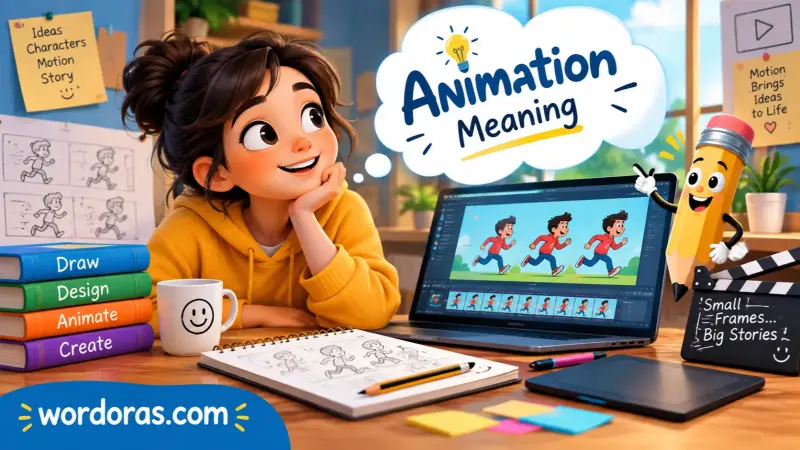
When people hear the word animation, they often think of cartoons, animated movies, or colorful characters moving across a screen. But the meaning of animation goes far beyond entertainment.
At its core, animation is the process of creating the appearance of movement by showing images, drawings, objects, or digital elements in sequence.
The word can also have a broader meaning: bringing something to life, energy, or activity.
That is why animation appears in so many areas today, from films and video games to advertising, education, social media, websites, and mobile apps.
Whether you are learning the term for school, work, or simple curiosity, you’ll find the answer right here.
Animation means the process of creating the appearance of movement using drawings, models, images, or computer-generated graphics. It can also mean energy, liveliness, or enthusiasm in someone’s behavior or speech. The correct meaning depends on the context in which the word is used.
What Does Animation Mean?
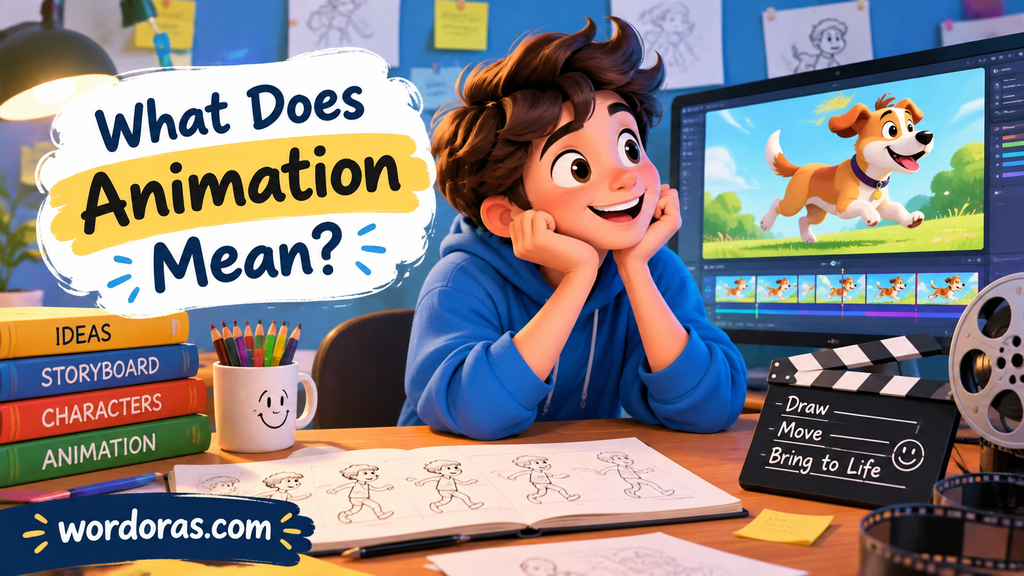
Animation usually means creating the appearance of movement from images, drawings, models, or digital graphics.
For example, cartoons, animated movies, motion graphics, and many video-game characters use animation to make still artwork appear to move.
But animation has another meaning in everyday English. It can describe energy, liveliness, or enthusiasm, especially in the way someone speaks, behaves, or expresses themselves.
For example:
“She spoke with great animation about her new project.”
Here, animation does not mean cartoons. It means that she spoke with noticeable energy and enthusiasm.
Cambridge gives these two major meanings: moving images created from drawings, models, or computers, and enthusiasm or energy in someone’s behavior. Oxford similarly lists animation as both the process of making moving images and a state of energy or enthusiasm.
So, in simple terms:
Animation = making something appear to move, or showing liveliness and energy.
Animation Meaning in Simple Words
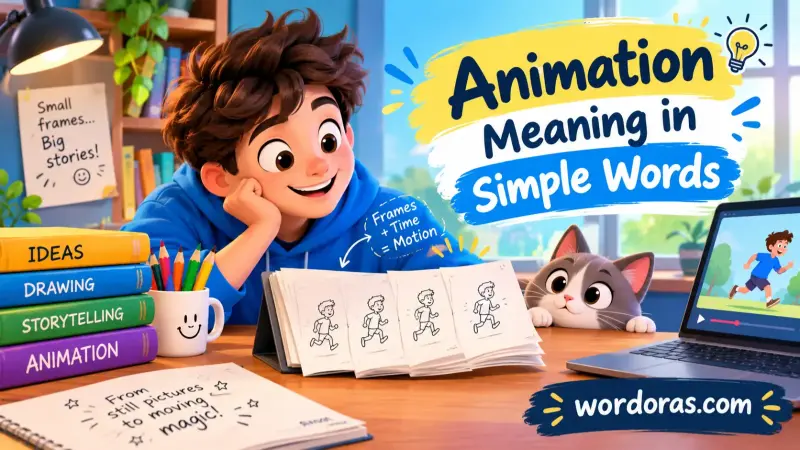
If you want the easiest possible definition:
Animation is the art or process of making pictures, objects, or computer-generated images appear to move.
It can also mean liveliness or enthusiasm.
Think about the difference:
- “I love animation.” → Usually means animated movies, cartoons, or the art of creating moving images.
- “He spoke with animation.” → Means he spoke energetically and enthusiastically.
- “The website has a small animation.” → Means it contains a moving visual effect.
- “Her face was full of animation.” → Means her expression looked lively and energetic.
The surrounding words usually make the intended meaning clear.
What Does Animation Mean in Movies and Cartoons?
In film and entertainment, animation is the process of creating the illusion that drawings, models, objects, or digital images are moving.
An animator does not necessarily record an object moving continuously like a traditional live-action camera would. Instead, movement can be created by presenting a sequence of images or frames in a way that makes the viewer perceive motion.
Animation can involve many techniques, including:
- Hand-drawn animation
- 2D digital animation
- 3D computer animation
- Stop-motion animation
- Puppet animation
- Clay animation
- Motion graphics
- Computer-generated imagery
Britannica describes animation as the process of giving an illusion of movement to drawings, models, or inanimate objects.
That is why animation is much broader than simply saying “cartoons.”
A cartoon may be animated, but animation can also be used for films, advertisements, educational videos, games, websites, scientific visualizations, and other forms of digital media.
Animation Meaning in Everyday English
The word has an older meaning that is easy to overlook.
In everyday English, animation can mean liveliness, energy, or enthusiasm.
For example:
“There was a lot of animation in the room.”
This could mean that people were lively, energetic, and actively engaged.
Another example:
“She told the story with great animation.”
This means she told it with energy, expression, and enthusiasm.
Cambridge defines this sense as “enthusiasm and energy,” while Oxford describes it as energy and enthusiasm in the way someone looks, behaves, or speaks.
This meaning is closely connected to the word’s historical idea of bringing something to life.
Where Does the Word Animation Come From?
The history of animation is closely connected to the Latin word anima, meaning “life” or “breath.”
The English noun animation appeared in the 1590s with a sense related to giving life. Over time, the word also developed the meaning of vitality or liveliness. Much later, it acquired its modern film-related sense involving moving pictures.
The Online Etymology Dictionary dates the cinematographic sense of animation to 1912. Oxford gives the moving-image sense as dating from the early 19th century, reflecting differences in how historical senses are dated and categorized.
So the basic idea behind the word has remained surprisingly consistent:
life → liveliness → making something appear alive or moving
That connection helps explain why the same word can describe both a lively person and moving visual art.
Animation Meaning by Context
The meaning of animation changes slightly depending on where you encounter it.
| Context | Meaning |
|---|---|
| Movies | The creation of moving images |
| Cartoons | Animated drawings or digital characters |
| Computer graphics | Movement created digitally |
| Video games | Moving characters, objects, or visual effects |
| Websites | Moving visual elements or effects |
| Education | Visual movement used to explain an idea |
| Conversation | Energy or enthusiasm |
| Personality | Liveliness or expressiveness |
| “Suspended animation” | A state involving temporarily suspended life functions |
Context matters because animation is not always about cartoons.
What Does Animation Mean in Texting or Online Conversations?
Unlike many modern slang terms, animation is not normally an abbreviation or texting acronym.
If someone writes:
“The animation was amazing.”
They are probably talking about animated visuals, a movie, game, video, or digital artwork.
If someone says:
“He spoke with animation.”
They are using the traditional English meaning of energy or enthusiasm.
Online, animation can also refer to a small moving visual, such as:
- A GIF
- A loading effect
- A button transition
- A character movement
- A short motion graphic
- An animated emoji or sticker
However, the word itself does not have one special hidden meaning in texting.
Real Conversation Examples
1: Movies
Alex: “Did you watch that new animated movie?”
Sam: “Yes. The animation was incredible.”
Here, animation means the visual art and movement used to create the movie.
Example 2: Conversation
Alex: “How was your presentation?”
Sam: “She explained everything with a lot of animation.”
Here, animation means energy and enthusiasm.
3: Websites
Alex: “Why does that button move when I hover over it?”
Sam: “That’s a simple animation.”
Here, animation refers to a digital movement or visual effect.
4: Games
Alex: “The character’s running animation looks realistic.”
Here, animation means the sequence of visual movements used to make the character appear to run.
5: Personality
Alex: “He tells stories with so much animation.”
This means he uses expressive energy, gestures, facial expressions, or an enthusiastic style.
Animation vs. Animated vs. Animate
These words are related, but they do different jobs.
Animation
Animation is a noun.
It can refer to the process or result of creating movement, or to energy and liveliness.
“The animation in the film was beautiful.”
“She spoke with animation.”
Animated
Animated is usually an adjective.
It can describe something created to appear to move:
“We watched an animated movie.”
It can also describe someone who is lively or energetic:
“They had an animated conversation.”
Cambridge specifically recognizes both senses of animated: moving images and a person or discussion that is full of interest and energy.
Animate
Animate can be a verb meaning to give something movement, life, or energy.
“The designer animated the character.”
It can also mean to make something more lively or active.
Cambridge defines the verb animate as causing someone or something to become more active or full of life.
A quick way to remember them:
Animate → the action
Animation → the process or result
Animated → the description
Is Animation the Same as a Cartoon?
Not exactly.
A cartoon is a particular type of visual artwork or entertainment, while animation is a broader process or medium.
For example, animation can be used to create:
- Cartoons
- Feature films
- Video-game sequences
- Explainer videos
- Advertising graphics
- Educational demonstrations
- Digital interfaces
- Short films
- Visual effects
So saying that all animation is cartoons is too narrow.
A cartoon can be animated, but animation itself covers a much wider range of techniques and uses.
Common Types of Animation
1. 2D Animation
2D animation works with images that have two-dimensional height and width.
Traditional hand-drawn cartoons are a familiar example, although modern 2D animation can also be created digitally.
2. 3D Animation
3D animation creates digital objects and characters with depth.
It is widely used in movies, games, advertisements, simulations, and other digital media.
3. Stop Motion Animation
Stop-motion uses physical objects or models.
The creator photographs the object in a series of slightly different positions. When the images are played sequentially, the object appears to move.
4. Motion Graphics
Motion graphics use movement to communicate information, ideas, branding, or visual effects.
You might see them in advertisements, presentations, title sequences, and online videos.
5. Computer Animation
Computer animation uses software to create and control moving images.
It can include both 2D and 3D techniques.
These categories can overlap. For example, a production may combine computer animation with traditional artistic techniques.
Why Is Animation Used?
Animation is useful because movement can communicate things that a static image cannot.
It can:
- Show how something works
- Explain complicated ideas
- Make information easier to visualize
- Create fictional worlds
- Bring characters to life
- Demonstrate movement
- Add visual interest to digital products
- Tell stories
- Present information in a memorable way
For example, an educational video might animate the movement of planets to explain an astronomical concept.
A software company might animate a button to show that it has been clicked.
A filmmaker might animate a fictional character to tell a story that would be difficult to create with live actors.
What Does “Animated Conversation” Mean?
This is one of the most common places where people misunderstand the word.
An animated conversation does not mean that the conversation contains cartoons.
It means the conversation is lively, energetic, excited, or expressive.
For example:
“They had an animated conversation about the new movie.”
The phrase suggests that they were interested and expressive while talking.
Cambridge uses animated for conversations or discussions that are full of interest and energy.
What Does “Animated Person” Mean?
An animated person is usually someone who expresses themselves with noticeable energy.
They might:
- Use expressive facial expressions
- Gesture while speaking
- Speak enthusiastically
- Show strong interest
- React visibly to what others say
For example:
“She became very animated when she started talking about music.”
This does not mean she literally began moving like a cartoon character.
It means her behavior became more lively and expressive.
Common Misunderstandings About Animation
“Animation only means cartoons.”
Not quite.
Animation includes cartoons, but it also includes digital graphics, stop-motion, games, educational visuals, advertisements, and many other forms.
“Animated always means made with computers.”
No.
Animation can be created using hand-drawn artwork, physical models, puppets, clay, photographs, computers, or combinations of techniques.
“Animation has only one meaning.”
No.
The word can describe moving images, but it can also mean energy, liveliness, or enthusiasm.
“Animation is the same as live action.”
No.
Live-action filmmaking generally records performances or real-world scenes through photography or digital video. Animation creates the appearance of movement through separately created or manipulated images, objects, or frames.
“Animation is only for children.”
No.
Animation is a medium rather than a single audience category. It can be used for children’s entertainment, adult storytelling, education, advertising, science, gaming, and many other purposes.
Synonyms and Related Words
The best alternative depends on which meaning of animation you intend.
When animation means moving images:
- Animated graphics
- Motion graphics
- Animated imagery
- Cartooning
- Visual effects
- Computer-generated imagery
- Moving images
These are related terms, but they are not always exact synonyms.
When animation means energy:
- Liveliness
- Enthusiasm
- Energy
- Vitality
- Excitement
- Expressiveness
- Spirit
For example:
“She spoke with animation.”
could be rewritten as:
“She spoke with enthusiasm.”
But the exact nuance can change depending on the sentence.
Animation Meaning in “Suspended Animation”
You may also encounter the phrase suspended animation.
Here, animation does not mean cartoons.
The phrase uses the older sense connected with life or vitality.
In general language, suspended animation refers to a state in which normal activity or life functions are temporarily suspended.
This is another example of why context matters when interpreting the word animation.
How to Use Animation Correctly in a Sentence
Use animation as a noun.
For visual movement:
“The animation in the game is smooth.”
“She studied animation at college.”
“The website uses subtle animation.”
For energy or enthusiasm:
“He told the story with animation.”
“Her speech was full of animation.”
“The room came alive with animation.”
The key is to make sure the meaning fits the context.
FAQs:
What is the simple meaning of animation?
Animation means creating the appearance of movement using drawings, images, models, objects, or computer-generated graphics. It can also mean energy, enthusiasm, or liveliness in someone’s behavior or speech.
What does animation mean in a movie?
In a movie, animation refers to the process of creating the appearance of movement through drawings, models, digital images, or other visual techniques. It is broader than simply making cartoons.
What does animation mean in a conversation?
In a conversation, animation usually means energy, enthusiasm, or liveliness. For example, “She spoke with animation” means she spoke in an energetic and expressive way.
What is the difference between animation and animated?
Animation is a noun referring to the process, result, or quality of being lively. Animated is an adjective that can describe moving images or someone who is energetic and expressive.
Is animation a type of art?
Yes. Animation can be treated as an art form and a production medium. It combines visual design, movement, timing, storytelling, sound, and technology or physical techniques.
Does animation always mean cartoons?
No. Cartoons are one form of animation. Animation is also used in films, games, advertisements, websites, educational material, simulations, and digital interfaces.
Final Takeaway:
The animation meaning depends on context, but its two main senses are easy to understand.
In film, media, technology, and art, animation means creating the appearance of movement from drawings, models, images, or digital graphics.
In everyday English, animation can mean energy, enthusiasm, liveliness, or expressiveness.
The two meanings are actually connected by the word’s history. The term comes from a Latin root associated with life and breath, and its early English meanings involved giving life or vitality.
The modern moving-image meaning developed later.
If the sentence discusses movies, cartoons, games, graphics, or visual effects, it probably means moving images.
If it describes a person, voice, conversation, or behavior, it may mean energy and enthusiasm.
That simple distinction covers most everyday uses of the word.

I’m Allen Vick, the creator of Wordoras.com, a website dedicated to making words, phrases, and their meanings simple and easy to understand.
I’m passionate about clear language and helping readers discover the meaning, usage, pronunciation, and context behind everyday words and expressions. Through Wordoras, I aim to make learning new words simple, practical, and enjoyable for everyone.
3 thoughts on “Animation Meaning Explained From Drawings to Moving Stories”