
Ever come across the word “scraping” and wondered what it actually means? You’re not alone. The term can sound simple, but its meaning changes depending on how it is used.
It may describe the everyday action of rubbing or removing something from a surface, or it can refer to a process used with computers and websites.
In everyday language, scraping usually means removing something from a surface by rubbing, dragging, or using a tool. For example, you might scrape ice from a car window, scrape paint from a wall, or scrape food from the bottom of a pan.
In the digital world, scraping often means collecting information from websites or other online sources using software. This is commonly called web scraping.
It can be used to gather product prices, public information, research data, or other details more efficiently.
So, what does scraping meaning really depend on? The answer is context. In this guide, we’ll explain the word in simple terms, explore its common meanings, and look at easy examples.
Whether you saw “scraping” in a conversation, a dictionary, or a technology article, you’ll have a clear understanding of what it means by the end.
Scraping usually means removing, rubbing, or collecting something by dragging a rough or sharp object across a surface. In technology, it can mean automatically extracting data from websites or other digital sources. Its exact meaning depends on context, such as “scraping paint,” “scraping by,” or “scraping data.”
What Does “Scraping” Mean?
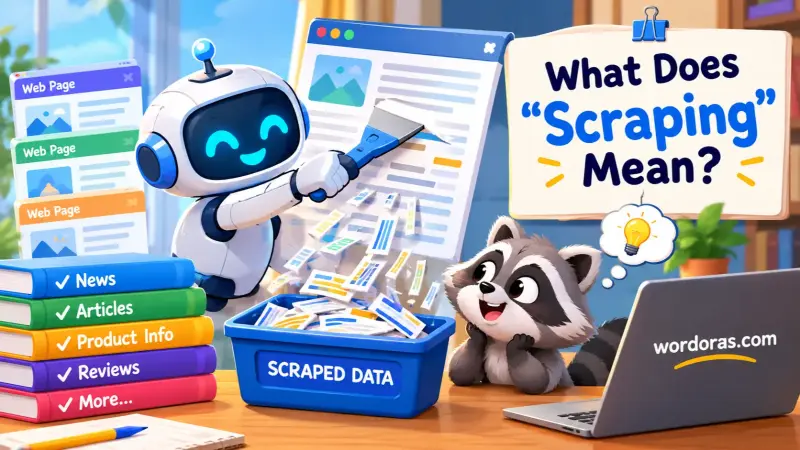
Scraping is the -ing form of the verb scrape, and its meaning depends heavily on the context.
In everyday English, scraping usually describes rubbing, removing, or collecting something from a surface. For example:
- “She is scraping ice off the windshield.”
- “He is scraping paint from the wall.”
- “The chair is scraping against the floor.”
The word also appears in expressions such as “scraping by,” which means managing to succeed or survive with very little margin.
In technology, scraping has a more specialized meaning. It can refer to using software to extract data from websites or other digital sources. Cambridge Dictionary specifically recognizes this technology-related use.
So, if someone says:
“The company is scraping product prices.”
they are probably talking about automated data collection, not someone physically rubbing a surface.
Quick meaning
Scraping can mean:
- Removing something from a surface.
- Rubbing against something and causing a mark or sound.
- Collecting something with difficulty.
- Barely succeeding or managing.
- Extracting digital information automatically.
The surrounding words usually tell you which meaning is intended.
Scraping Meaning in Everyday English
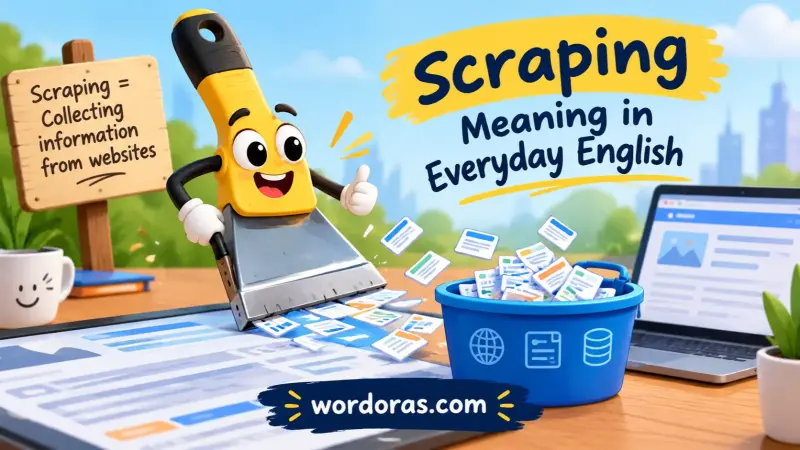
The most traditional meaning of scraping involves a physical surface.
You scrape something when you use a rough or sharp object to remove material, clean something, or rub against a surface.
For example:
- Scraping ice off a car.
- Scraping food from a pan.
- Scraping old paint from a door.
- Scraping mud from shoes.
- Scraping wax from a table.
Cambridge defines scrape as removing an unwanted covering or top layer, often with something sharp or rough. It also includes the sense of rubbing against a surface in a way that can cause slight damage or an unpleasant sound.
Example
“I spent the morning scraping old paint off the fence.”
Here, scraping means physically removing the paint.
Scraping Can Also Mean Rubbing
Sometimes scraping describes the contact between two surfaces rather than the removal of something.
For example:
“The metal was scraping against the concrete.”
This means the metal was rubbing across the concrete and producing friction, damage, or a harsh sound.
You might also hear:
- “The branch was scraping the window.”
- “My shoe is scraping the floor.”
- “The chair legs kept scraping against the tiles.”
This meaning is closely related to the physical action of scraping.
What Does “Scraping By” Mean?
One of the most useful expressions containing the word is “scraping by.”
To scrape by means to manage to survive, succeed, or get something done with only just enough resources or ability.
For example:
“I’m scraping by on a tight budget this month.”
This means the speaker is managing financially, but only with difficulty.
Another example:
“She scraped by in the final exam.”
Here, the person passed, but probably only narrowly.
Cambridge describes this sense as succeeding with difficulty or by a very small amount.
“Scrape by” examples
- “We’re scraping by until payday.”
- “He scraped by with the minimum passing grade.”
- “They managed to scrape by despite the difficult season.”
This expression is different from web scraping. The two uses share the same root word but describe completely different activities.
What Does “Scraping Together” Mean?
Another common expression is “scrape together.”
It means to gather something gradually, often when you do not have much of it.
The thing being gathered is frequently money, resources, people, or supplies.
For example:
“We scraped together enough money for the trip.”
This means the people involved managed to collect enough money, probably from several small amounts.
Other examples:
- “They scraped together a team at the last minute.”
- “I scraped together enough cash to replace my phone.”
- “We scraped together the materials we needed.”
This usage comes from the broader idea of gathering something bit by bit or with difficulty. Dictionary sources document this sense of scrape.
What Does “Scraping” Mean in Technology?
In technology, scraping usually means automatically extracting information from a digital source.
The most common example is web scraping.
A program can visit web pages, read information from their underlying content, and collect selected data into a structured format.
For example, a researcher might collect:
- Product names
- Prices
- Publicly listed reviews
- Article titles
- Public business information
- Search-result information
- Sports statistics
Cambridge includes “getting data from a website” as a technology-related meaning of scrape.
Dictionary.com similarly defines the digital-technology sense as extracting data from a digital source for automated replication, formatting, manipulation, data mining, or website analysis.
Simple example
Imagine a website has 500 product pages.
Instead of manually copying every product name and price, a software program can be designed to collect those fields automatically.
That process is commonly called web scraping.
Important distinction
Scraping does not automatically mean hacking.
The word itself describes a method of extracting information. Whether a particular scraping activity is permitted, prohibited, or legally complicated depends on factors such as the website’s rules, applicable law, the type of information involved, and how the collected data is used.
So it is better not to treat “scraping” and “hacking” as synonyms.
Web Scraping vs. Data Scraping
These terms overlap, but they are not always used in exactly the same way.
| Term | General meaning |
|---|---|
| Web scraping | Automatically collecting information from websites |
| Data scraping | Extracting data from a digital source more generally |
| Web crawler | A program that automatically visits web pages |
| Data extraction | The broader process of obtaining usable information from a source |
| Manual scraping | Collecting information by hand rather than automatically |
For a person searching “scraping meaning,” the important point is simple: in a technology context, scraping generally means extracting digital information automatically or systematically.
Does “Scraping” Have a Special Texting or Slang Meaning?
Unlike some internet slang terms, “scraping” does not have one widely established texting meaning that replaces its normal dictionary meanings.
If you see “scraping” in a text, message, comment, or social-media post, context matters.
For example:
“I’m scraping by this month.”
This means the person is managing with difficulty.
But:
“They’re scraping the website for prices.”
means they are collecting digital data.
And:
“My knee is scraping the ground.”
refers to physical contact.
Therefore, it is risky to assume that scraping is automatically slang just because it appears in an online conversation.
Scraping Meaning by Context
The easiest way to understand the word is to look at the words around it.
| Context | Meaning | Example |
|---|---|---|
| Cleaning | Removing something from a surface | “Scraping ice off the car” |
| Physical contact | Rubbing against a surface | “The box is scraping the floor” |
| Injury | Causing a minor abrasion | “I scraped my knee” |
| Money/resources | Gathering something with difficulty | “We scraped together enough money” |
| Success | Barely managing to succeed | “She scraped by” |
| Technology | Extracting digital information | “The program is scraping data” |
This is why a single definition can sometimes be misleading. “Scraping” is a context-dependent word with several established uses.
How to Use “Scraping” in a Sentence
Here are natural examples from different contexts.
Physical meaning
“He was scraping mud off his boots.”
Removing a layer
“They spent the afternoon scraping old wallpaper from the wall.”
Rubbing
“The drawer is scraping against the frame.”
Minor injury
“She fell and ended up scraping her elbow.”
Barely succeeding
“We were scraping by during the first few months.”
Gathering resources
“They scraped together enough money to repair the car.”
Technology
“The researchers used software for scraping publicly available web data.”
The grammar is straightforward: scraping can function as the present participle of scrape and can also be used as a noun referring to the activity itself.
Scraping vs. Scratching: What’s the Difference?
Scraping and scratching are related, but they are not always interchangeable.
Scratching usually suggests making a mark with something pointed, such as a fingernail or sharp object.
Scraping often suggests dragging something rough or sharp across a surface, frequently to remove material or create friction.
Compare:
“The cat scratched the sofa.”
with:
“He scraped the paint off the sofa.”
The first emphasizes making marks. The second emphasizes removing material.
There can be overlap, especially when describing physical damage, so context still matters.
Common Misunderstandings About “Scraping”
1. Thinking scraping only means web scraping
Because “web scraping” is common in technology discussions, some people assume scraping always refers to computers.
It does not.
The word has been used for physical actions for centuries. Its digital meaning is a later specialized use.
2. Assuming scraping means hacking
Web scraping and hacking are not synonymous.
Scraping generally refers to extracting information. The circumstances surrounding the extraction determine whether the activity raises security, contractual, privacy, copyright, or other legal concerns.
3. Assuming “scraping by” means scraping something
In “scraping by,” the word is part of an idiom.
“I’m scraping by.”
does not mean the speaker is physically scraping an object.
It means they are managing, surviving, or succeeding with very little margin.
4. Treating scraping as internet slang
“Scraping” can certainly appear in online conversations, but that does not make it a dedicated slang term.
Its meaning normally comes from the established meanings of scrape and the context in which it appears.
Where Does the Word “Scrape” Come From?
The history of scrape is much older than computers and the internet.
Etymological sources trace the verb to Middle English scrapen, with connections to Old Norse skrapa and Old English forms associated with scratching or scraping.
The modern word developed several related meanings over time.
These include:
- Removing something from a surface
- Rubbing against something
- Collecting something with difficulty
- Barely succeeding
- Getting into a difficult situation
The digital meaning developed much later as computing created new ways to extract and process information.
This makes the technology meaning a useful example of how an existing English word can gain a specialized meaning in a newer field.
When Should You Use “Scraping”?
Use scraping when the context clearly involves one of its established meanings.
It works naturally when talking about:
- Removing material
- Rubbing against a surface
- Minor abrasions
- Gathering limited resources
- Barely succeeding
- Automated data extraction
In technical writing, make the meaning more specific when necessary.
For example, instead of writing:
“We used scraping.”
you could write:
“We used web scraping to collect publicly available product information.”
That version immediately tells the reader what kind of scraping you mean.
When Should You Avoid the Word?
Avoid using scraping when another word communicates the action more precisely.
For example:
- Copying may be better when information was manually copied.
- Crawling may be better when discussing automated discovery of web pages.
- Downloading may be better when an entire file was retrieved.
- Extracting may be better in formal technical documentation.
- Collecting may be better when describing manual data gathering.
The best word depends on what actually happened.
Similar Words and Alternatives
Depending on the context, useful alternatives include:
For physical scraping
- rubbing
- scratching
- scuffing
- abrading
- removing
- peeling
For gathering
- collecting
- accumulating
- assembling
- gathering
- pulling together
😊For “scraping by”
- managing
- surviving
- getting by
- barely succeeding
- making do
For technology
- extracting
- collecting data
- harvesting data
- automated data extraction
- web data collection
These alternatives are not perfect synonyms in every sentence, so replacing scraping should always take the original context into account.
FAQs:
What is the simple meaning of scraping?
Scraping generally means removing, rubbing, or collecting something through a scraping action. In technology, it commonly means extracting information from a website or other digital source.
What does scraping mean in texting?
There is no single universal texting definition of scraping. In a message, its meaning depends on context. “Scraping by” means managing with difficulty, while “scraping data” usually refers to digital data extraction.
What does web scraping mean?
Web scraping is the process of using software or another systematic method to extract information from websites. It is commonly used to collect structured information from online pages.
What does “scraping by” mean?
“Scraping by” means managing or succeeding with difficulty or only a small margin of success. For example, someone who has just enough money to cover essential expenses might say they are scraping by.
Is scraping the same as scratching?
Not exactly. Scratching usually involves making a mark or damaging a surface with something pointed or rough, while scraping often involves dragging something across a surface to remove material or create friction. The meanings can overlap.
Is scraping a slang word?
Not primarily. Scraping is a standard English word with several established meanings. It can appear in casual online conversation, but its meaning normally comes from context rather than from a special universal slang definition.
Conclusion:
Understanding the scraping meaning is easier when you pay attention to the context. The word can describe a simple physical action, an expression, or a technology-related process.
In daily conversation, scraping often refers to rubbing, dragging, or removing something from a surface. For example, you might scrape mud off your shoes or scrape leftover food from a plate.
The expression “scraping by” has a different meaning, describing a situation where someone manages to get by with very little. In the digital world, web scraping means gathering information from websites with the help of software or automated tools.
The easiest way to understand the word is to look at the words around it. “Scraping paint” refers to a physical action, “scraping by” is an idiomatic expression, while “scraping data” usually refers to a digital process.
Once you recognize the context, the meaning becomes much clearer. Whether you encounter the word in everyday conversation, reading, or a technology article, you can usually understand what scraping means without much confusion.

I’m Allen Vick, the creator of Wordoras.com, a website dedicated to making words, phrases, and their meanings simple and easy to understand.
I’m passionate about clear language and helping readers discover the meaning, usage, pronunciation, and context behind everyday words and expressions. Through Wordoras, I aim to make learning new words simple, practical, and enjoyable for everyone.
2 thoughts on “Scraping Meaning in Simple English What It Really Means”