
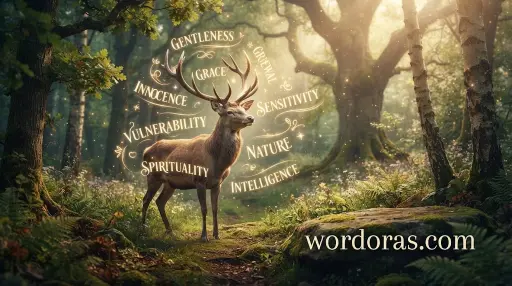
The word deer usually refers to a hoofed animal known for its slender body, long legs, and often graceful movements.
Deer live in many parts of the world and can be found in forests, grasslands, mountains, and other natural habitats. They are often recognized by their large ears and, in many species, the antlers grown by males.
But what exactly does deer mean when you see it in a sentence, story, or conversation? The answer is usually simple, although the word can have slightly different uses depending on context.
It can describe the animal itself, a particular species, or deer as a group.
In this guide, we’ll explain the deer meaning in simple English, look at its definition, pronunciation, plural form, common uses, and a few easy examples.
By the end, you’ll have a clear understanding of this familiar word.
Deer means a hoofed mammal belonging to the family Cervidae, usually recognized by its long legs and, in many species, antlers. The plural is normally deer, not deers. The word comes from Old English dēor, which originally meant “animal” or “wild beast” before developing its modern, more specific meaning. Deer is also a homophone of dear.
What Does “Deer” Mean?
A deer is a hoofed, plant-eating mammal belonging to the Cervidae family.
Deer are generally known for:
- Long, slender legs
- Hooves
- A plant-based diet
- Fast running ability
- Antlers in many species, especially among males
There are many kinds of deer, including red deer, roe deer, fallow deer, reindeer, and white-tailed deer. The exact appearance and antler characteristics vary between species.
Simple definition
Deer = a hoofed mammal of the Cervidae family.
For example:
- “We saw a deer near the forest.”
- “A herd of deer crossed the road.”
- “The deer ran into the woods.”
Deer Pronunciation
In American English, deer is commonly pronounced /dɪr/.
In British English, it is commonly represented as /dɪə(r)/.
The interesting part is that deer and dear are homophones. They have the same pronunciation but different meanings and spellings.
- deer → the animal
- dear → loved, valued, or used as a term of affection
For example:
“I saw a deer in the park.”
versus:
“She is a dear friend.”
Is “Deer” Singular or Plural?
Deer can be both singular and plural.
This is one of the most common points of confusion.
| Number | Correct form | Example |
|---|---|---|
| Singular | deer | “I saw one deer.” |
| Plural | deer | “I saw five deer.” |
So you normally say:
One deer
Two deer
A herd of deer
The standard plural is deer, although deers can occur in some specialized or dialectal usage. Major learner dictionaries give deer as the normal plural form.
Is “deers” correct?
For ordinary modern English, deer is the natural plural:
“There were several deer in the field.”
You generally would not write:
“There were several deers in the field.”
Deer vs. Dear: What’s the Difference?
Deer and dear sound alike, but they are completely different words.
😊Deer
Deer is a noun referring to an animal.
“The deer disappeared into the forest.”
Dear
Dear has several uses. It can describe something loved or valued, or it can be used when addressing someone affectionately.
“She is a dear friend.”
“Thank you, dear.”
Oxford lists dear as an adjective and noun with uses involving affection, value, and friendly forms of address.
Easy memory trick
Think:
deer = animal
dear = someone or something you care about
That simple distinction can help prevent spelling mistakes.
Origin and Evolution of the Word “Deer”
The history of deer is surprisingly unusual.
The modern word comes from Old English dēor. However, dēor did not originally mean only the animal we now call a deer. It was a much broader word meaning an animal, beast, or wild creature.
Oxford likewise traces modern deer to Old English dēor, noting that it originally referred to any four-legged animal.
Over time, the meaning became narrower.
In other words:
Old English dēor → animal/wild beast
↓
Middle English der/deer → increasingly associated with particular game animals
↓
Modern English deer → animals in the Cervidae family
The specialized meaning became established during the Middle English period and was essentially complete by around the end of that period.
A fascinating linguistic connection
The older meaning is still visible in related Germanic languages.
For example, the German word Tier means “animal.” Dutch dier also means “animal.” These words are related to the English deer.
So although modern English deer has a very specific meaning, its linguistic relatives can preserve the older, broader idea of “animal.”
How to Use “Deer” in a Sentence
Here are some natural examples.
Everyday examples
“A deer was standing beside the road.”
“We watched a group of deer from a distance.”
“The deer quickly ran into the forest.”
“There were several deer in the meadow.”
“She took a photograph of a deer.”
More descriptive examples
“The young deer moved quietly through the trees.”
“A large deer appeared at the edge of the field.”
“We spotted a herd of deer just before sunset.”
These examples show that deer normally functions as a noun.
Meaning of “Deer” by Context
The basic meaning stays the same, but the context can tell you what kind of deer someone means.
1. Wildlife
“The deer lives in the forest.”
Here, deer refers to the animal generally.
2. A specific animal
“Look! There’s a deer behind the house.”
Here, the speaker is referring to one particular animal.
3. A group
“We saw ten deer near the lake.”
Here, deer is plural.
4. Hunting or wildlife management
You may also encounter deer in discussions about hunting, habitats, populations, conservation, and wildlife management.
The exact species may be identified with another word, such as white-tailed deer, red deer, or fallow deer.
What Is a Male Deer Called?
The name for a male deer can depend on the species and context.
Common terms include:
- Buck
- Stag
- Hart
A buck is widely used for male deer, while stag is commonly used for an adult male deer, particularly certain larger species. Terminology can vary by species and regional usage.
A female deer is commonly called a doe, while a young deer is often called a fawn.
This gives you a useful basic vocabulary:
| Term | Common meaning |
|---|---|
| Deer | General animal |
| Buck | Male deer |
| Doe | Female deer |
| Fawn | Young deer |
| Stag | Adult male deer in certain usage |
| Hind | Female deer in certain species/contexts |
Is “Deer” a Slang Word?
No. Deer is not primarily slang or texting language.
It is a standard English noun used in everyday conversation, writing, wildlife discussions, literature, and scientific contexts.
If someone sends “deer” in a text message, the intended meaning is normally simply the animal—unless the context suggests they made a spelling mistake involving dear.
For example:
“I saw a deer today 🦌”
Here, the meaning is straightforward.
But:
“Goodnight, deer ❤️”
could potentially be a playful misspelling of dear, because dear can be used affectionately.
Context matters.
Common Misunderstandings About “Deer”
1. Deer always means a male animal
Not necessarily.
Deer is a general term and can refer to the animal without specifying sex.
2. The plural is always “deers”
Usually, no.
The standard plural is deer:
“Three deer were grazing.”
3. Deer and dear mean the same thing
They do not.
They are homophones—words that sound alike but have different meanings and spellings.
4. Deer originally always meant the animal we know today
Historically, this is not correct.
Old English dēor had a much broader meaning, referring to animals or wild beasts generally.
Related Words and Terms
If you’re learning vocabulary around deer, these words are useful:
- Doe — commonly a female deer
- Buck — commonly a male deer
- Fawn — a young deer
- Stag — an adult male deer in certain contexts
- Hind — a female deer in certain contexts
- Antler — a branching structure grown by many male deer
- Herd — a group of deer
- Cervidae — the biological family containing deer
Learning these words can make descriptions of deer much more precise.
Deer in Common Expressions
The word appears in several compounds and phrases.
Examples include:
Deer park — an enclosed area where deer are kept or managed.
👍Deer hunting — hunting deer.
Deer mouse — a type of mouse associated with deer in its common name.
Reindeer — a particular member of the deer family.
Deerskin — the hide or skin of a deer.
These compounds use deer in its modern animal-related sense.
Why Does “Deer” Sound Like “Dear”?
Because English has many words that share a pronunciation while having different spellings and meanings.
These are called homophones.
For example:
- deer / dear
- flower / flour
- right / write
- sea / see
So if someone says deer and dear aloud, you generally need the surrounding sentence to know which word they mean.
Written English removes that ambiguity because the spelling is different.
When Should You Use “Deer”?
Use deer when you’re referring to the animal or the deer family in general.
Examples:
“We saw a deer in the woods.”
“Deer often live in woodland habitats.”
“The park is home to a large deer population.”
Use dear instead when you’re expressing affection, describing something valued, or addressing someone affectionately.
“She is my dear friend.”
“Thank you, dear.”
FAQs:
What is the simple meaning of deer?
Deer means a hoofed mammal belonging to the family Cervidae. The word can refer to one animal or multiple animals because deer is normally unchanged in the plural.
What is the plural of deer?
The usual plural is deer.
“One deer”
“Five deer”
The plural does not normally require an -s.
Is deer and dear the same word?
No. Deer means the animal, while dear has meanings related to affection, value, or friendly forms of address. They are homophones because they sound alike.
What did deer mean in Old English?
Old English dēor had a much broader meaning than modern deer. It could refer to an animal, beast, or wild creature generally. Its meaning gradually became more specialized.
Is deer a slang word?
No. Deer is a standard English word, not primarily slang. In ordinary communication, it refers to the animal.
What is a baby deer called?
A young deer is commonly called a fawn. The terminology can vary depending on the species, but fawn is the familiar general term.
Final Takeaway:
The deer meaning is simple in modern English: it refers to a hoofed mammal in the Cervidae family. The word can describe one animal or several, so deer works as both singular and plural.
What makes the word especially interesting is its history. Old English dēor originally had the broader meaning of “animal” or “wild beast.” Over centuries, that broad meaning narrowed until deer became the specific animal word we use today.
And remember the spelling distinction:
deer = animal 🦌
dear = loved, valued, or affectionate
That small spelling difference can save you from a surprisingly common English mistake.

I’m Allen Vick, the creator of Wordoras.com, a website dedicated to making words, phrases, and their meanings simple and easy to understand.
I’m passionate about clear language and helping readers discover the meaning, usage, pronunciation, and context behind everyday words and expressions. Through Wordoras, I aim to make learning new words simple, practical, and enjoyable for everyone.