
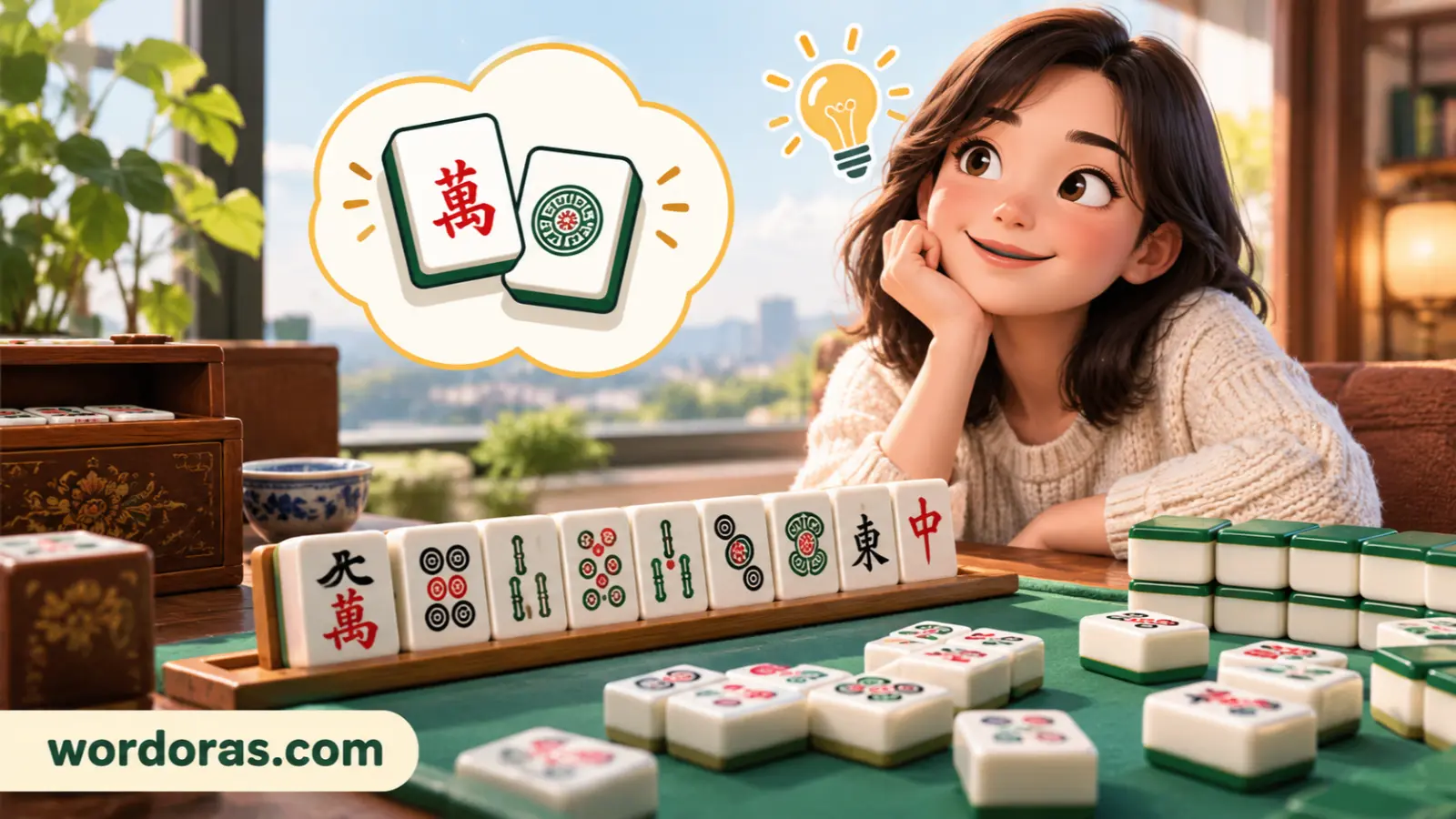
Mahjong is a traditional tile-based game that brings together strategy, observation, and a little luck. If you have heard someone mention mahjong or seen its colorful tiles, you may wonder what the word means and why the game has remained popular for so long.
In simple English, mahjong refers to a game in which players draw, match, and discard tiles to build winning combinations.
The game originated in China and is commonly played by four people, although rules and versions can vary. Its tiles feature different symbols, numbers, and characters, making each round a mix of planning and quick decisions.
While mahjong may look complicated to beginners, learning the basic rules can make it much easier to understand.
Today, mahjong is enjoyed in many parts of the world, both as a social activity and as a mental challenge. Some people play with family and friends, while others enjoy digital versions on their phones or computers.
Understanding the meaning of mahjong helps explain not only what the game is but also why it continues to bring people together across generations.
What Does Mahjong Mean?
Mahjong means a traditional game played with decorated tiles. Players draw, discard, and collect tiles to create specific combinations, with the goal of completing a winning hand.
The word is also commonly spelled mah-jong or mah-jongg. All these forms refer to the same general game, although spelling preferences vary by region and organization.
Here is the meaning in simple terms:
- Literal context: The name is associated with the Chinese word for “sparrow.”
- Game context: A tile-based game involving strategy, pattern recognition, and some luck.
- Online context: A digital version of the traditional game or a tile-matching puzzle inspired by its tiles.
- Social context: An activity people enjoy with family, friends, or other players.
For example:
“My grandparents play mahjong every Sunday.”
This means the grandparents regularly get together to play the tile game.
Another example:
“I downloaded a mahjong game to relax after work.”
This could refer to a traditional multiplayer version or a single-player puzzle app, depending on the game.
What Does the Word Mahjong Literally Mean?
The name mahjong is commonly traced to a Chinese term meaning “sparrow.” This connection is part of the word’s linguistic history, rather than a separate modern slang definition.
One popular explanation is that the clattering sound made when players shuffle the tiles resembles sparrows chirping. However, this explanation should be treated as a proposed explanation for the name, not an indisputable fact.
It is useful to distinguish between the literal meaning of a word and what it refers to in everyday English.
For example, someone who says, “We’re playing mahjong tonight,” is talking about the game, not about birds.
Likewise, if a friend sends you a message saying, “Want to learn mahjong?”, they are probably inviting you to learn how to play.
Where Did Mahjong Originate?
Mahjong originated in China, with the game in its recognizable modern form emerging during the 19th century. Historical accounts generally place its development in the coastal regions of southeastern China, although the precise place and circumstances of its invention remain debated.
The game became popular in China before spreading internationally. It reached the United States in the early 20th century and gained considerable attention during the 1920s. American players later developed their own version, with distinctive rules and conventions.
Today, mahjong is played in different forms around the world, including Chinese, Japanese, and American versions.
Although these versions share a common foundation, they do not always use identical rules, scoring systems, or winning combinations.
One important historical distinction is that mahjong is not generally considered an ancient game invented by Confucius. Its documented development belongs to a much more recent period, and the exact origins remain a subject of historical discussion.
How Does Mahjong Work?
At first glance, mahjong can look complicated because the tiles contain unfamiliar characters, numbers, and symbols. However, the central idea is straightforward: collect the right tiles to make a valid hand.
Traditional mahjong is commonly played by four people using a set of tiles. Players take turns drawing and discarding tiles while trying to complete combinations that satisfy the rules of their particular version.
Understanding the tiles
Traditional sets contain several categories of tiles. The exact set depends on the version being played.
| Tile category | What it includes |
|---|---|
| Dots or circles | Tiles marked with circular patterns |
| Bamboo | Tiles featuring bamboo-like designs |
| Characters | Tiles marked with Chinese numerals or characters |
| Winds | East, South, West, and North |
| Dragons | Special honor tiles |
| Bonus tiles | Flowers and seasons in versions that include them |
The three numbered suits form much of the foundation of the game. Honor tiles and bonus tiles add further possibilities, depending on the rules.
How players win
In many traditional versions, a standard winning hand consists of four sets and one pair. A set may be a sequence of consecutive numbers in the same suit or a group of identical tiles.
For instance, three consecutive numbered tiles in one suit can form a sequence, while three matching tiles can form a triplet.
A player usually needs to draw and discard tiles strategically until the hand is complete. Some versions also allow special winning hands that do not follow the standard pattern.
This combination of planning, observation, and chance is what makes mahjong more than a simple matching game.
Mahjong vs. Mahjong Solitaire: What’s the Difference?
One of the most common misunderstandings about mahjong comes from online games. The name is used for two related but different activities.
Traditional mahjong
Usually played by four people, this game involves drawing and discarding tiles, forming combinations, and following a regional set of rules. Players compete to complete a winning hand.
Mahjong solitaire
A single-player puzzle in which you remove matching, eligible tiles from a layered arrangement. The goal is generally to clear the board by finding matching pairs.
Mahjong solitaire uses mahjong-style tiles, but its rules are different from traditional multiplayer mahjong. The distinction matters when someone recommends a game or asks whether you know how to play.
For example:
- “My family plays mahjong together” usually refers to the traditional game.
- “I play mahjong on my phone before bed” might refer to solitaire.
- “I joined a mahjong club” generally suggests a group that plays a particular traditional version.
What Does Mahjong Mean in Texts and Chats?
Unlike common internet abbreviations such as LOL, BRB, or IMO, mahjong is not a standard texting acronym or widely recognized slang expression.
When someone uses the word in a text, its meaning usually stays close to the game’s ordinary definition.
Here are a few realistic examples.
Example 1: Making plans
Alex: Are you free Saturday afternoon?
Jamie: Yes! We’re having a mahjong night if you want to join.
Meaning: Jamie is inviting Alex to a social gathering where people will play mahjong.
Example 2: Talking about a hobby
Alex: What do you do when you need a break?
Jamie: Usually read or play mahjong on my phone.
Meaning: Jamie enjoys reading or playing a digital mahjong game during free time.
Example 3: Learning something new
Alex: My aunt keeps asking me to learn mahjong.
Jamie: You should try it. It’s easier to understand once you learn the tiles.
Meaning: The conversation is about learning the rules of the traditional tile game.
Example 4: Discussing a puzzle
Alex: I finished that mahjong game in ten minutes!
Jamie: The one where you match pairs?
Meaning: The speakers are likely discussing mahjong solitaire rather than the traditional four-player game.
These examples illustrate a simple principle: the surrounding conversation tells you which version of mahjong someone means.
Mahjong Meaning by Context
The same word can refer to slightly different experiences depending on where you encounter it.
| Context | Likely meaning |
|---|---|
| Family gatherings | A traditional tile game played socially |
| Gaming websites | A multiplayer mahjong game or a solitaire puzzle |
| Mobile apps | Often a digital tile-matching puzzle, but sometimes traditional mahjong |
| Clubs and tournaments | Organized play using a particular ruleset |
| Cultural discussions | The game’s Chinese origins, history, and international variations |
| Everyday conversation | The game as a hobby, pastime, or social activity |
There is no need to assume that the word has a hidden meaning simply because it appears in an unfamiliar setting.
For example, if someone writes, “I’m addicted to mahjong lately,” they probably mean that they enjoy playing it frequently. They are not necessarily using a special internet expression.
Is Mahjong a Game of Skill or Luck?
Mahjong involves both skill and chance.
Players cannot fully control which tiles they draw, so luck plays a role. However, decisions about which tiles to keep or discard, which combinations to pursue, and how to respond to other players can also influence the outcome.
The balance between skill and luck varies with the version and the circumstances of play.
Mahjong is therefore not simply a game of memorizing patterns. In traditional versions, players also need to understand the rules, assess their options, and adjust their strategy as the game develops.
In mahjong solitaire, the challenge is different. Players look for available matching pairs and consider which moves will leave useful options for later.
When Should You Use the Word Mahjong?
Use mahjong when discussing the game, its tiles, its rules, or an activity based on it.
Natural examples include:
- “My friends taught me how to play mahjong.”
- “We bought a new mahjong set.”
- “Do you know the rules of American mahjong?”
- “I’m looking for a mahjong solitaire app.”
- “The community center is hosting a mahjong evening.”
The word works in casual conversation, articles, gaming discussions, and cultural writing.
If you are talking about a specific version, name it when the distinction matters. Saying “Japanese mahjong,” “American mahjong,” or “mahjong solitaire” gives the reader a clearer idea of what you mean.
Common Misunderstandings About Mahjong
A few misconceptions can make the word confusing for new readers.
1. Mahjong and mahjong solitaire are identical.
They are not. Traditional mahjong is a tile-based game built around drawing, discarding, and forming winning hands. Mahjong solitaire is a separate matching puzzle.
2. Mahjong is a texting abbreviation.
There is no widely established standard acronym meaning behind the word. In ordinary usage, it refers to the game.
3. Every version uses the same rules.
Different regional versions have different rules, scoring systems, and winning conditions. Learning one version does not automatically mean you know every other version.
4. Mahjong was invented thousands of years ago.
The game’s development is generally traced to 19th-century China. Claims that it was invented by an ancient philosopher such as Confucius are not supported by reliable historical evidence.
5. The game is always about gambling.
Mahjong has historically been associated with gambling in some settings, but people also play it socially, recreationally, and competitively without wagering money.
Similar Games and Related Terms
If you are learning about mahjong, these related terms can help clarify the differences between tile games and other familiar activities.
| Term | Meaning |
|---|---|
| Mahjong solitaire | A single-player puzzle involving matching and removing tiles |
| Rummy | A card game in which players form sets or runs |
| Dominoes | A game played with rectangular pieces marked with numbers or patterns |
| Tile-matching game | A broad category of puzzles involving matching similar pieces |
| American mahjong | A regional version with its own rules and conventions |
| Japanese mahjong | A regional version commonly associated with riichi rules and distinctive scoring |
Rummy is sometimes used as a rough comparison because both traditional mahjong and rummy involve forming combinations. However, their rules and playing materials are different.
FAQs:
1. What does mahjong mean in simple English?
Mahjong is a traditional Chinese tile game in which players collect and arrange tiles to make winning combinations. The word is also used for digital versions, including single-player matching puzzles.
2. Does mahjong mean sparrow?
The name is commonly associated with a Chinese word meaning “sparrow.” The exact historical explanation for how the bird name became the game’s name is less certain than the game’s general Chinese origins.
3. Is mahjong Chinese or Japanese?
Mahjong originated in China. It later spread to other countries, where players developed regional versions, including Japanese mahjong. The two versions share historical roots but have important differences in rules and scoring.
4. Is mahjong the same as matching tiles?
Not exactly. Traditional mahjong involves drawing and discarding tiles to complete a winning hand. Mahjong solitaire focuses on removing matching pairs from a layout. Both use similar-looking tiles, but the gameplay differs.
5. Is mahjong a slang word?
No, not in its usual meaning. Mahjong is the name of a game, not a standard texting abbreviation or established slang term. A particular group could use it as an inside joke or nickname, but that meaning would depend on the group.
6. How do you use mahjong in a sentence?
You can say, “My family plays mahjong on weekends,” or “I downloaded a mahjong solitaire game.” In both sentences, the word refers to a game, although the specific type differs.
Final Takeaway:
The meaning of mahjong is straightforward: it is a traditional tile-based game that originated in China and is now played in many forms around the world.
The name is commonly linked to the Chinese word for “sparrow,” while its everyday English meaning refers to the game itself.
Depending on the context, mahjong may describe traditional multiplayer play or a digital puzzle inspired by its tiles.
If you encounter the word in a message, an article, or a game app, look at the surrounding context to determine which version is intended. There is usually no hidden slang meaning to decode.
For anyone exploring the term for the first time, the most useful distinction is between traditional mahjong and mahjong solitaire: they share a visual style, but they offer different ways to play.

I’m Allen Vick, the creator of Wordoras.com, a website dedicated to making words, phrases, and their meanings simple and easy to understand.
I’m passionate about clear language and helping readers discover the meaning, usage, pronunciation, and context behind everyday words and expressions. Through Wordoras, I aim to make learning new words simple, practical, and enjoyable for everyone.