
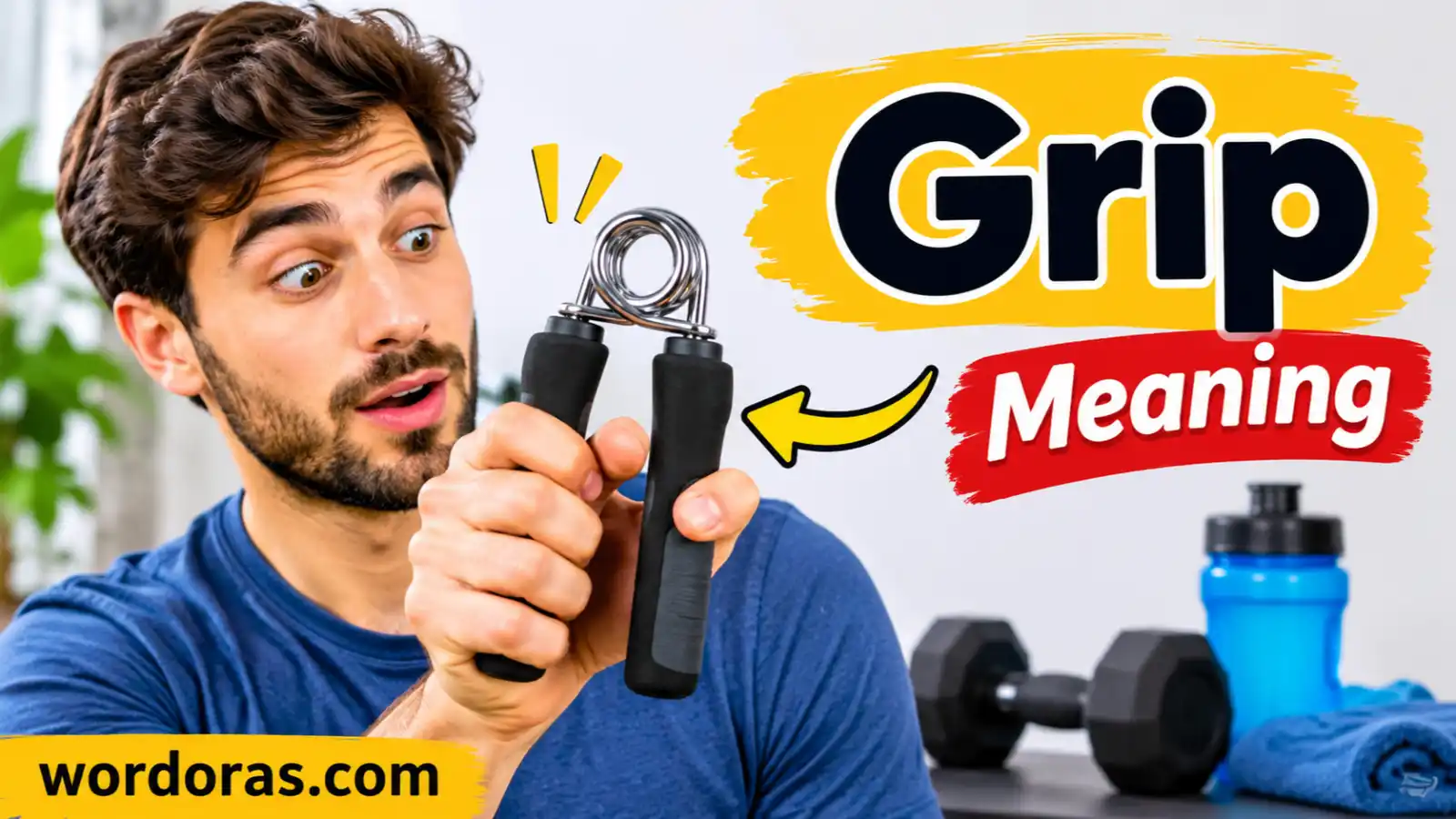
Have you ever heard someone say, “Get a grip,” or describe a person as having a strong grip? The word grip may seem simple, but it has several meanings depending on how it is used.
Generally, grip means to hold something firmly, keep a secure hold, or maintain control over a situation. It can also describe the way someone holds an object, such as a steering wheel, phone, or sports equipment.
In everyday English, grip is used in conversations, sports, work, and even emotional situations. But that’s not all grip can also have different meanings in common expressions and informal language.
Understanding its meaning can help you recognize how people use it in different contexts.
In this guide, you’ll what grip means, its different definitions, practical examples, common phrases, and how to use this word naturally in everyday conversations.
Featured Snippet Answer:
Grip means to hold something firmly or maintain control over it. It can also describe a person’s understanding, influence, or ability to manage a situation. As a noun, grip refers to a firm hold or grasp. In everyday English, expressions such as “get a grip” often mean to regain emotional control or think more clearly.
What Does Grip Mean?
The word grip generally means to hold something tightly or securely so it does not slip away. It can describe holding a physical object, such as a handle, steering wheel, or rope.
However, its meaning is not limited to physical contact. People also use it when talking about control, understanding, attention, and emotional reactions.
For example:
- Physical meaning: She had a strong grip on the suitcase.
- Control: He finally got a grip on his responsibilities.
- Understanding: I’m beginning to get a grip on this subject.
- Attention: The movie had a grip on the audience.
- Emotional control: Try to get a grip and stay calm.
In simple words, grip means a firm hold, strong control, or the ability to keep something under control.
It can function as both a noun and a verb, which is why it appears in many different sentences.
Grip as a Noun vs. Grip as a Verb
One important thing to understand is that grip can be used in two different grammatical ways.
| Form | Meaning | Example |
|---|---|---|
| Noun | A firm hold | He has a strong grip. |
| Noun | Control or influence | She has a grip on the situation. |
| Noun | A handle or gripping surface | The tool has a rubber grip. |
| Verb | To hold tightly | Grip the railing. |
| Verb | To attract attention | The story gripped me. |
| Verb | To affect someone emotionally | Fear gripped him. |
1. Grip as a Noun
As a noun, grip describes the act, strength, or ability of holding something firmly. It can also refer to control or understanding.
Examples:
- The athlete has an excellent grip.
- She tightened her grip on the rope.
- He has a good grip on English grammar.
- The manager maintained a firm grip on the project.
In these sentences, the word describes something a person has or maintains.
2. Grip as a Verb
As a verb, grip describes the action of holding something tightly or affecting someone strongly.
Examples:
- Grip the handle before lifting the box.
- The child gripped his father’s hand.
- Fear gripped everyone in the room.
- The documentary gripped viewers from beginning to end.
The verb form changes depending on the sentence:
- Present: grip
- Past: gripped
- Present participle: gripping
- Third-person singular: grips
For example:
“She grips the steering wheel tightly.”
“She gripped the steering wheel during the storm.”
Both sentences describe holding something firmly, but they use different verb tenses.
Grip Meaning in Texting and Online Conversations
If you encounter grip in a text message, its meaning usually depends on the surrounding words.
It is important to understand that grip is not a standard texting abbreviation or acronym with one special digital meaning. It is an ordinary English word that people also use in casual messages.
Here are some ways it might appear in online conversations.
1. Get a grip
This expression usually means to calm down, control your emotions, or start thinking more reasonably.
Example:
- Person A: I’m panicking because I have two assignments.
- Person B: Get a grip. You still have time.
Depending on the relationship, this can sound encouraging, teasing, or rude.
2. Have a grip on something
This means understanding or controlling something.
Example:
- Person A: Do you understand the new project?
- Person B: Yeah, I have a pretty good grip on it now.
3. Grip it tightly
This is a direct instruction to hold something firmly.
Example:
- Person A: How should I carry this box?
- Person B: Grip it tightly so it doesn’t fall.
4. This story has a grip on me
This means something has captured your attention or emotions.
Example:
- Person A: Are you still watching that series?
- Person B: Yes! It has a grip on me.
In casual digital communication, the word can also appear in jokes, comments, captions, and discussions about sports, games, and relationships.
Common Expressions and Idioms Using Grip
Some of the most useful meanings of this word appear in everyday expressions. Learning these phrases will help you understand conversations more naturally.
1. Get a Grip
Common expression
“Get a grip” means to regain control of your emotions, behavior, or thoughts.
People often say it when someone is panicking, overreacting, or struggling to think clearly.
Examples:
- Get a grip! Everything will be fine.
- You need to get a grip before the meeting starts.
- I told myself to get a grip and focus on the problem.
Tone: Informal. It can sound supportive between friends but dismissive or insulting in a serious situation.
2. Lose Your Grip
“Lose your grip” means to lose control or become unable to manage a situation properly.
It can also describe losing your physical hold on something.
Examples:
- He lost his grip on the ladder.
- The company seems to be losing its grip on the market.
- She felt as if she was losing her grip on reality.
3. Have a Firm Grip
This expression means to have a strong physical hold or a good level of control and understanding.
Examples:
- The goalkeeper has a firm grip on the ball.
- She has a firm grip on the company’s finances.
- He has a firm grip on the basic principles of mathematics.
4. Come to Grips With Something
This expression means to begin understanding, accepting, or dealing with a difficult situation or problem.
Examples:
- I’m still coming to grips with the news.
- The team must come to grips with its financial problems.
- It took him months to come to grips with the changes.
This phrase is especially useful when discussing difficult experiences, new responsibilities, or complicated subjects.
5. In the Grip of Something
This means being strongly affected or controlled by something, often an unpleasant situation, emotion, or condition.
Examples:
- The city was in the grip of a severe storm.
- She was in the grip of fear.
- The country remained in the grip of an economic crisis.
6. Tighten Your Grip
“Tighten your grip” means to hold something more firmly or increase control over something.
Examples:
- Tighten your grip on the handle.
- The organization tightened its grip on security.
- He tightened his grip on the rope.
7. Grip Someone’s Attention
This means to attract and hold someone’s interest.
Examples:
- The opening scene gripped my attention.
- Her speech gripped the audience.
- The mystery novel immediately gripped its readers.
These expressions demonstrate how one simple word can communicate physical strength, emotional reactions, understanding, and control.
Grip Meaning in Different Contexts
The meaning of grip can change slightly depending on the subject being discussed.
Here are some common contexts.
1. Grip in Sports
In sports, grip usually refers to how firmly an athlete holds equipment or how well their shoes or hands maintain contact with a surface.
Examples:
- A tennis player needs a proper grip on the racket.
- Football players need shoes with good grip.
- The golfer adjusted his grip before taking the shot.
A good grip can improve stability, control, and performance.
2. Grip in Driving
In driving, grip refers to how well vehicle tires maintain contact with the road.
For example:
“The tires have poor grip on wet roads.”
This means the tires may struggle to maintain traction, making it harder to control the vehicle.
Other examples:
- Snow can reduce tire grip.
- Good tire grip helps improve road handling.
- The driver lost grip on the slippery road.
3. Grip in Fitness and Exercise
In fitness, grip refers to the strength of your hands and fingers when holding weights or exercise equipment.
Examples:
- My grip gets tired during heavy deadlifts.
- Grip strength is important for weightlifting.
- She improved her grip by practicing with resistance equipment.
You may also hear the term grip strength, which describes how strongly someone can hold or squeeze an object.
4. Grip in Business
In business, grip often refers to control, management, or understanding.
Examples:
- The new manager has a good grip on daily operations.
- The company is trying to maintain its grip on the market.
- We need to get a better grip on our expenses.
In these examples, the word does not describe physically holding anything. Instead, it communicates authority or understanding.
5. Grip in Movies and Entertainment
In entertainment, grip has two particularly useful meanings.
First, something can grip an audience by keeping its attention.
Example:
“The thriller gripped viewers until the final scene.”
Second, a grip is a technical crew member who works with camera support, equipment, and sometimes lighting-related setups on film productions.
This is a professional film-industry meaning rather than a casual expression.
6. Grip in Tools and Everyday Objects
A grip can also refer to the part of an object designed to make it easier to hold.
Examples:
- The knife has a comfortable rubber grip.
- This bicycle has textured handlebar grips.
- The screwdriver’s grip makes it easier to use.
In this context, the word is closely related to a handle or handhold.
Does Grip Have a Slang Meaning?
Yes, grip has some informal slang uses, although its ordinary dictionary meanings are much more common.
One American slang use is “a grip,” meaning a large amount of something, especially money.
For example:
- He spent a grip on those new shoes.
- That car must have cost a grip.
- She made a grip of money from the business.
This usage is informal and may be more familiar in particular American communities and regional speech. It is not the best interpretation of the word in every conversation.
The surrounding sentence matters.
For example:
- “Get a grip” means regain control.
- “Hold your grip” refers to maintaining a firm hold.
- That costs a grip” can mean that something costs a lot of money in slang.
Do not automatically assume that every use of grip refers to money or internet slang.
Origin and Evolution of the Word Grip
The word grip has a long history in English.
According to historical dictionary sources, it comes from Old English grippan, meaning to seize, grasp, or take hold of something. Its noun usage developed from related older words referring to a grasp or handful. Definition of Grip by Merriam-W+1
Over time, the word developed several figurative meanings.
Originally, its central idea was physical holding or seizing. That meaning gradually extended to situations where someone holds control, maintains authority, or captures another person’s attention.
For example:
- Physical: He gripped the rope.
- Mental: She has a grip on the subject.
- Emotional: Fear gripped the child.
- Social: The organization maintained its grip on power.
This development explains why the same word works in so many different situations.
The expression “get a grip on yourself” also developed from the idea of taking hold of something physically and applying it to controlling your emotions or behavior. Dictionary.com+1
Grip Meaning in Different Everyday Situations: More Examples
Sometimes, seeing a word in complete sentences makes its meaning easier to understand than reading a dictionary definition.
Here are additional examples from everyday English.
| Sentence | Meaning |
|---|---|
| Hold the cup with a firm grip. | Hold it tightly. |
| I need to get a grip on my schedule. | I need to organize and control my schedule. |
| The movie had a strong grip on me. | The movie kept my attention. |
| He has a weak grip. | He cannot hold things very strongly. |
| Fear gripped her suddenly. | She suddenly felt intense fear. |
| The team lost its grip on the game. | The team lost control of the game. |
| These shoes have excellent grip. | The shoes provide good traction. |
| I’m getting to grips with the new software. | I’m learning how to understand and use it. |
When Should You Use the Word Grip?
Use grip when you want to describe holding, control, understanding, or strong influence.
Here are some situations where it fits naturally:
- Physical situations: When describing someone holding an object tightly.
- Learning: When talking about understanding a difficult subject.
- Emotions: When describing a powerful feeling that affects someone.
- Sports: When discussing equipment handling or traction.
- Work: When explaining control over responsibilities or projects.
- Entertainment: When describing something that keeps an audience interested.
For example, instead of saying, “I understand this topic well,” you could say, “I have a good grip on this topic.”
Both sentences are correct, but the second sounds slightly more conversational.
When NOT to Use Grip
Although grip is a flexible word, it does not replace every word related to holding or understanding.
Avoid using it when another word communicates your meaning more naturally.
For example:
- Instead of “Grip my attention carefully,” say “Pay attention carefully.”
- Instead of “I grip what you’re saying,” say “I understand what you’re saying.”
- Instead of “Grip the opportunity,” say “Take the opportunity.”
- Instead of “Grip the problem,” say “Address the problem.”
Also, be careful with the expression “get a grip.”
Telling someone to “get a grip” when they are genuinely upset may sound insensitive. In professional or sensitive conversations, a more considerate expression is usually better.
For example:
- Less considerate: Get a grip and stop worrying.
- More considerate: Take a breath. We can work through this together.
Common Misunderstandings About Grip
People sometimes misunderstand this word because it has both literal and figurative meanings.
Here are a few mistakes worth avoiding.
1. Thinking grip only means holding something
Grip can describe physical holding, but it can also mean control, understanding, or influence.
2. Thinking grip is always slang
Grip is a standard English word, not exclusively internet slang. Its informal expressions are only part of its overall usage.
3. Confusing grip with grasp
These words are closely related, but they are not always interchangeable. Grasp can mean understanding something, while grip often emphasizes firm holding or control.
4. Assuming “get a grip” is always friendly
The expression can be humorous between friends, but it can also sound impatient or disrespectful.
5. Confusing grip with a texting abbreviation
Grip is not generally used as a standard abbreviation for a longer phrase. Its meaning usually comes from ordinary English vocabulary and context.
Similar Words and Alternatives to Grip
Several English words have meanings similar to grip. However, the best alternative depends on the sentence.
| Word | Meaning | Example |
|---|---|---|
| Hold | Keep something in your hand | Hold the glass. |
| Grasp | Take hold of or understand | She grasped the concept. |
| Clutch | Hold tightly | He clutched his bag. |
| Clasp | Hold or fasten firmly | She clasped his hand. |
| Grab | Take something quickly | Grab your jacket. |
| Grasp | Understand an idea | I grasp the situation now. |
| Control | Have authority over something | She controls the project. |
| Traction | Ability to maintain contact with a surface | The tires need more traction. |
Grip vs. Grasp
Both words can mean holding something firmly.
However, grasp is also frequently used to describe understanding an idea or concept.
Examples:
- Grip: He gripped the steering wheel.
- Grasp: He finally grasped the meaning of the lesson.
Grip vs. Hold
Hold is a more general word. It simply means keeping something in your hand or maintaining a position.
Grip often suggests a firmer or stronger hold.
Examples:
- Hold the book.
- Grip the book tightly so it doesn’t fall.
Grip vs. Grab
Grab usually describes taking something quickly or suddenly.
Grip emphasizes maintaining a firm hold.
Examples:
- Grab the phone before it falls.
- Grip the phone securely while walking.
Choosing the right alternative helps make your English sound more natural and precise.
FAQs:
1. What does grip mean in simple English?
Grip means to hold something tightly or maintain control over it. It can also mean understanding something or having a strong influence over a situation.
2. What does get a grip mean in texting?
In texting, “get a grip” usually means calm down, control your emotions, or think more clearly. It is an informal expression that can sound supportive, teasing, or rude depending on the conversation.
3. Is grip a noun or a verb?
Grip can be both. As a noun, it means a firm hold or control. As a verb, it means to hold something tightly or capture someone’s attention.
4. What does lose your grip mean?
“Lose your grip” means losing physical control of something or becoming unable to manage a situation. It can also describe someone struggling to maintain emotional or mental control.
5. What does grip mean in slang?
In some informal American slang, “a grip” can mean a large amount of money or something. However, this is a context-dependent usage. The ordinary meaning remains a firm hold or control.
6. What does have a good grip on something mean?
It means having a strong understanding or good control of something.
For example, “She has a good grip on mathematics” means she understands mathematics well.
Final Takeaway:
The word grip has several useful meanings in everyday English. Its main meaning is to hold something firmly, but it can also describe control, understanding, attention, and emotional influence.
You may encounter it in ordinary conversations, text messages, sports discussions, workplaces, and common expressions such as “get a grip” and “come to grips with something.”
The easiest way to understand it is to look at the surrounding sentence. If someone is holding an object, grip usually means a firm hold. If someone is discussing a problem or emotion, it may refer to control or understanding.
Learning these different uses will help you recognize the word and use it naturally in everyday communication.

I’m Allen Vick, the creator of Wordoras.com, a website dedicated to making words, phrases, and their meanings simple and easy to understand.
I’m passionate about clear language and helping readers discover the meaning, usage, pronunciation, and context behind everyday words and expressions. Through Wordoras, I aim to make learning new words simple, practical, and enjoyable for everyone.